
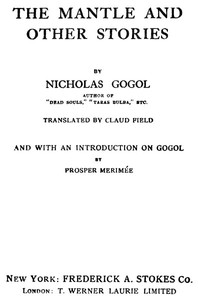
The Mantle, and Other Stories
Written by Nikolai Vasilevich Gogol
Chaptra reads alongside you — AI insights, chapter breakdowns and reader discussions for every book. Join free
About this book
Reading guide
Themes, characters and key ideas in The Mantle, and Other Stories, written by Chaptra AI.
- about 8 hours
- intermediate
- dark
- humorous
- satirical
Nikolai Gogol's "The Mantle, and Other Stories" is a seminal collection that masterfully blends satire, realism, and the grotesque to expose the absurdities and tragedies of 19th-century Russian society. The titular novella, "The Mantle," centers on Akaki Akakievitch, a humble and ridiculed government clerk whose life revolves around his mundane copying duties. His desperate pursuit of a new overcoat, which becomes a symbol of dignity and identity, leads to a brief moment of happiness followed by profound despair and ultimately, a spectral return for justice. Through these tales, Gogol critiques bureaucracy, social hierarchy, and the dehumanizing effects of poverty and indifference, cementing his legacy as a pioneer of Russian literary realism and the absurd.
“"There are all sorts of clerks in the department... But Akaky Akakievitch was regarded as something quite insignificant."”
Key themes
- Social Alienation and Dehumanization
- Gogol vividly portrays the profound isolation of individuals within a rigid social hierarchy. Akaki Akakievitch is an extreme example of someone utterly ignored and undervalued by society, treated as less than human. His identity is so intertwined with his job that he becomes a mere cog in the bureaucratic machine, invisible until his overcoat briefly grants him a fleeting connection to the world.
- The Significance of Material Possessions (and Identity)
- The overcoat in the titular story transcends its practical function to become a symbol of Akaki's identity, dignity, and aspirations. For Akaki, acquiring the new coat is not just about warmth, but about gaining a sense of self-worth and social acceptance that he has never experienced. Its loss equates to the loss of his very being.
- Bureaucracy and Corruption
- Gogol ruthlessly satirizes the inefficiency, indifference, and often corrupt nature of the Russian bureaucratic system. The government department is a place where rules and rank supersede human empathy, and where a man's worth is measured by his title and ability to navigate its arbitrary hierarchies, rather than his intrinsic value.
Worth discussing
How does Gogol use humor and satire to critique Russian society and bureaucracy in "The Mantle"?
Chapter-by-chapter breakdowns, character arcs and the full thematic analysis come with a free account.
Discussions
No one has started one yet
Questions this book opens up
No discussions yet
Be the first to start a discussion about this book!
Sign up to start the discussionReviews
No reviews yet
Be the first to review this book!