
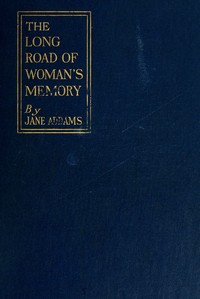
The long road of woman's memory
Written by Jane Addams
Chaptra reads alongside you — AI insights, chapter breakdowns and reader discussions for every book. Join free
About this book
Reading guide
Themes, characters and key ideas in The long road of woman's memory, written by Chaptra AI.
- about 10 hours
- advanced
- reflective
- analytical
- empowering
Jane Addams's "The Long Road of Woman's Memory" is a profound collection of essays exploring the unique contributions of women to human civilization, particularly through their capacity for social ethics, pacifism, and the transmission of historical memory. Addams argues that women's experiences, often rooted in maternal care and community building, have fostered a distinct moral perspective essential for societal progress and peace. Through historical analysis and contemporary observation, she champions women's often-overlooked roles in shaping culture, advocating for their full participation in public life. The book serves as a foundational text in feminist thought, social work theory, and peace studies, urging a re-evaluation of women's historical significance.
“The long road of woman's memory is filled with the unrecorded efforts of generations of women who have striven for the preservation of life.”
Key themes
- Women's Historical Memory and Social Contribution
- Addams argues that women possess a distinct historical memory, often unrecorded in official histories, that emphasizes the preservation of life, social cohesion, and ethical development. She highlights how women's contributions, though often confined to the domestic sphere, have been crucial for the progress and maintenance of civilization, contrasting this with male-dominated narratives of conquest and power.
- Pacifism and Non-Violence
- A core argument of the book is that women, due to their life-giving and nurturing roles, inherently possess a stronger inclination towards pacifism than men. Addams views war as an inherently masculine pursuit that goes against the fundamental ethical framework developed by women. She advocates for women's increased participation in public and political life as a means to foster international peace and prevent conflict.
- Feminist Thought and Women's Rights
- The book is a powerful statement for women's suffrage and broader women's rights, grounded in a unique philosophical framework. Addams argues that denying women full participation in public life not only harms women but deprives society of essential ethical perspectives and practical solutions. Her feminism is rooted in the belief that women's distinct contributions are necessary for human progress.
Worth discussing
How does Addams define 'woman's memory' and how does it differ from traditional historical narratives?
Chapter-by-chapter breakdowns, character arcs and the full thematic analysis come with a free account.
Discussions
No one has started one yet
Questions this book opens up
No discussions yet
Be the first to start a discussion about this book!
Sign up to start the discussionReviews
No reviews yet
Be the first to review this book!