
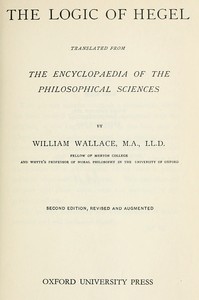
The Logic of Hegel
Written by Georg Wilhelm Friedrich Hegel
Chaptra reads alongside you — AI insights, chapter breakdowns and reader discussions for every book. Join free
About this book
Reading guide
Themes, characters and key ideas in The Logic of Hegel, written by Chaptra AI.
- about 60 hours
- advanced
- Profound
- Challenging
- Intellectual
Georg Wilhelm Friedrich Hegel's "The Logic of Hegel" is a foundational philosophical treatise that redefines logic not merely as a tool for thought, but as the very structure of reality itself, serving as the first part of his "Encyclopaedia of the Philosophical Sciences." Hegel systematically unfolds the categories of pure thought, from the most abstract concept of Being to the Absolute Idea, through his revolutionary dialectical method. He posits that genuine knowledge transcends empirical observation, delving into the underlying rational interconnectedness of God, nature, and spirit. The work challenges readers to embrace a rigorous, disciplined approach to understanding reality, asserting that truth is not static but a dynamic process of conceptual self-unfolding, ultimately equating thought with the objective structure of the cosmos.
“What is rational is actual and what is actual is rational.”
Key themes
- The Dialectical Method
- This is the core methodology of Hegel's philosophy. It describes the process by which concepts develop through their internal contradictions: a thesis gives rise to its antithesis, and their conflict is resolved in a higher synthesis (Aufhebung) that transcends and preserves aspects of both. This process is not merely a method of thinking but is presented as the very structure of reality itself, driving the unfolding of being, essence, and concept.
- Absolute Idealism
- The doctrine that reality is fundamentally mental, spiritual, or rational, and that the ultimate nature of existence is the Absolute Idea or Spirit (Geist). This means that thought and being are ultimately identical, and that the world is an expression of a self-developing, rational process. There is no ultimate reality independent of mind or consciousness; rather, reality is the unfolding of reason itself.
- The Nature of Truth and Knowledge
- Hegel redefines truth not as a static correspondence between thought and object (correspondence theory), but as a dynamic process of conceptual development and self-realization. True knowledge is not merely subjective understanding but the comprehensive grasp of the rational structure of reality, which unfolds through the dialectical movement. It is the 'whole' that is true, not just isolated propositions or immediate perceptions.
Worth discussing
How does Hegel's dialectical method challenge conventional understandings of logic and truth?
Chapter-by-chapter breakdowns, character arcs and the full thematic analysis come with a free account.
Discussions
No one has started one yet
Questions this book opens up
No discussions yet
Be the first to start a discussion about this book!
Sign up to start the discussionReviews
No reviews yet
Be the first to review this book!