
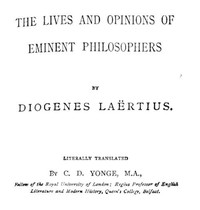
The Lives and Opinions of Eminent Philosophers
Written by Diogenes Laertius
Chaptra reads alongside you — AI insights, chapter breakdowns and reader discussions for every book. Join free
About this book
Reading guide
Themes, characters and key ideas in The Lives and Opinions of Eminent Philosophers, written by Chaptra AI.
- about 50 hours
- advanced
- Informative
- Scholarly
- Historical
Diogenes Laertius's "The Lives and Opinions of Eminent Philosophers" is an indispensable ancient Greek text from the late 2nd century AD, offering a vast compilation of biographical sketches, philosophical doctrines, and anecdotes concerning over 80 Greek philosophers. Organized by philosophical schools and lineages, the work begins with an exploration of philosophy's origins before delving into figures like Thales, Socrates, Plato, and Aristotle. It preserves numerous fragments of lost works and provides crucial insights into the development of ancient Greek thought, serving as a primary source for understanding the intellectual history of the classical world. While its accuracy is debated, its sheer scope and preservation of doxographical and biographical material make it a cornerstone for the study of ancient philosophy.
“Know thyself.”
Key themes
- The Nature of Philosophy
- Laertius's entire work is an exploration of what philosophy is, not through abstract definition alone, but through the lives and opinions of those who practiced it. He presents philosophy as a diverse, evolving discipline encompassing metaphysics, ethics, logic, and physics, demonstrating its fundamental role in understanding the world and guiding human conduct. The different schools represent various approaches to these core questions.
- Transmission and Preservation of Knowledge
- The very act of Laertius's compilation underscores the theme of knowledge transmission. He meticulously records teacher-student lineages, lists of works, and summaries of doctrines, demonstrating how philosophical ideas were passed down, debated, and developed across generations. The work itself is a monumental effort to preserve what was known about these thinkers, many of whose original writings are now lost.
- The Diversity and Evolution of Thought
- Laertius's work is a testament to the vast array of philosophical perspectives that flourished in ancient Greece. By presenting different schools and their often-conflicting doctrines side-by-side, he implicitly explores the dynamic evolution of thought, showing how later philosophers built upon, reacted against, or radically diverged from their predecessors. This highlights the intellectual ferment and continuous search for answers.
Worth discussing
To what extent can we trust Diogenes Laertius's accounts, given his anecdotal approach and potential biases?
Chapter-by-chapter breakdowns, character arcs and the full thematic analysis come with a free account.
Discussions
No one has started one yet
Questions this book opens up
No discussions yet
Be the first to start a discussion about this book!
Sign up to start the discussionReviews
No reviews yet
Be the first to review this book!