
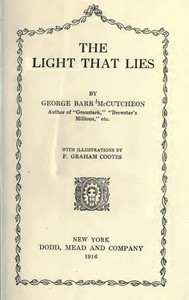
The Light that Lies
Written by George Barr McCutcheon
Chaptra reads alongside you — AI insights, chapter breakdowns and reader discussions for every book. Join free
About this book
Read it with a club
Small groups reading the same books and talking as they go.


News
- 4 members
- 1,813 discussions
- Active Sep 11
Read The Light that Lies alongside people who are reading it too.
Also here: News Bulletin, Just Joking....
Chaptra Prime — paid clubs, every club feature, and unlimited reading support, for $5 a month or $60 once.
See PrimeReading guide
Themes, characters and key ideas in The Light that Lies, written by Chaptra AI.
- about 8 hours
- intermediate
- intriguing
- thought-provoking
- romantic
George Barr McCutcheon's "The Light that Lies" introduces Sampson, a wealthy man accustomed to evading civic duties, particularly jury service. Circumstances thrust him into a high-profile embezzlement trial involving an elderly defendant, James W. Hildebrand, and his compelling granddaughter, Alexandra. Initially resentful, Sampson finds himself increasingly drawn into the intricacies of the case and the moral dilemmas it presents. As he grapples with the evidence and the justice system's complexities, his growing feelings for Alexandra challenge his biases and force a profound re-evaluation of his principles and responsibilities.
“Jury duty, a vexing distraction, until the very lives of others hung upon my reluctant judgment.”
Key themes
- Justice and Morality
- The novel deeply explores the complexities of the legal system, questioning whether justice is merely the application of law or if it must also encompass empathy and moral discernment. It delves into the struggle between objective evidence and subjective human interpretation, highlighting the ethical dilemmas faced by those tasked with judgment.
- Perception vs. Reality
- The story emphasizes how initial perceptions, often based on superficial judgments or societal biases, can obscure the underlying truth. Sampson's journey is fundamentally about seeing beyond the surface – from his initial view of jury duty as an annoyance to understanding the profound human reality at stake.
- Social Responsibility and Duty
- A core theme is Sampson's evolution from evading civic duty to embracing it. The novel critiques the detachment of the privileged from societal obligations and champions the importance of active participation in the democratic process, particularly in upholding the justice system.
Worth discussing
How does Sampson's initial avoidance of jury duty reflect broader societal attitudes towards civic responsibility?
Chapter-by-chapter breakdowns, character arcs and the full thematic analysis come with a free account.
Discussions
No one has started one yet
Questions this book opens up
No discussions yet
Be the first to start a discussion about this book!
Sign up to start the discussionReviews
No reviews yet
Be the first to review this book!