
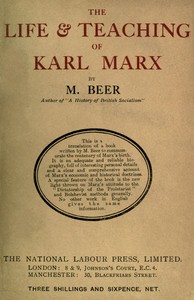
About this book
Reading guide
Themes, characters and key ideas in The life and teaching of Karl Marx, written by Chaptra AI.
- about 8 hours
- advanced
- Informative
- Analytical
- Historical
Max Beer's "The Life and Teaching of Karl Marx" offers an early 20th-century historical account meticulously tracing the intellectual and personal evolution of Karl Marx. The book delves into Marx's formative years in Treves, examining the familial and academic influences that shaped his philosophical trajectory, particularly his profound engagement with Hegelian dialectics. Beer illuminates Marx's relentless pursuit of knowledge, his pivotal relationships with contemporaries like Friedrich Engels, and his eventual commitment to radical social criticism. This work serves as a foundational biography, detailing the development of Marxism from its philosophical roots to its emergence as a powerful framework for understanding and transforming society, emphasizing Marx's role as a founding figure in modern socialist thought.
“Beer meticulously traces Marx's intellectual journey, revealing how the fertile soil of Hegelian thought blossomed into a radical critique of capitalism.”
Key themes
- Historical Materialism and Dialectics
- Central to Beer's analysis is the exposition of Marx's core philosophical framework: historical materialism and the application of dialectics to social analysis. The book explains how Marx inverted Hegel's idealism, positing that material conditions and economic relations, rather than ideas, are the primary drivers of historical change. It details how the dialectical method—the interplay of opposing forces—is applied to understand class struggle as the engine of historical progress.
- Intellectual Evolution and Development
- This theme explores how Marx's thought developed over time, from his early engagement with Hegelian philosophy to his eventual formulation of historical materialism. Beer meticulously traces the influences, debates, and personal experiences that shaped Marx's intellectual trajectory, emphasizing the dynamic and iterative nature of his theoretical construction. It highlights the process of critical inquiry and synthesis that led to his unique contributions.
- Social Criticism and Revolutionary Thought
- Beer highlights Marx's unwavering commitment to social criticism and the development of revolutionary thought. The book shows how Marx's theoretical work was not merely academic but deeply intertwined with a desire to understand and ultimately transform society. It emphasizes Marx's view that philosophy should not just interpret the world but change it, leading to his advocacy for a classless, communist society.
Worth discussing
How does Beer's early 20th-century perspective shape his portrayal of Marx, and how might this differ from contemporary biographies?
Chapter-by-chapter breakdowns, character arcs and the full thematic analysis come with a free account.
Discussions
No one has started one yet
Questions this book opens up
No discussions yet
Be the first to start a discussion about this book!
Sign up to start the discussionReviews
No reviews yet
Be the first to review this book!