
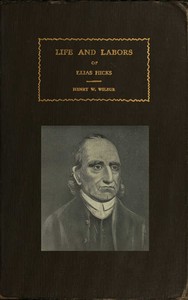
The Life and Labors of Elias Hicks
Written by Henry Watson Wilbur
Chaptra reads alongside you — AI insights, chapter breakdowns and reader discussions for every book. Join free
About this book
Reading guide
Themes, characters and key ideas in The Life and Labors of Elias Hicks, written by Chaptra AI.
- about 8 hours
- advanced
- Historical
- Spiritual
- Contemplative
Henry Watson Wilbur's "The Life and Labors of Elias Hicks" offers an in-depth biographical exploration of Elias Hicks, a pivotal figure in the Society of Friends during the late 18th and early 19th centuries. The book meticulously chronicles Hicks' spiritual evolution from his formative years in a Quaker household on Long Island to his emergence as a prominent minister. It delves into the development of his unique theological perspectives, particularly his emphasis on the 'Inner Light' and its implications for Quaker practice and doctrine. Wilbur's work primarily focuses on the profound spiritual journey of Hicks, detailing his unwavering commitment to his understanding of faith and the significant controversies that ultimately led to a major schism within the Quaker community. The biography positions Hicks as a dedicated man of faith whose life and ministry left an indelible mark on religious history.
“"The true light is within, a divine spark guiding the sincere heart, more certain than any outward teaching."”
Key themes
- Spiritual Conviction and the Inner Light
- This is the core theological theme, exploring Elias Hicks' profound belief in and emphasis on the 'Inner Light' or 'Inward Christ' as the direct and primary source of divine guidance for every individual. The book delves into how this conviction shaped Hicks' ministry, his understanding of scripture, and his critique of external forms of worship and creed. It highlights the deeply personal and experiential nature of faith as central to true Quakerism, according to Hicks.
- Religious Dissent and Schism
- The book meticulously details the theological disagreements and interpersonal conflicts that led to the 'Great Separation' within the Society of Friends. It explores how differing interpretations of fundamental doctrines, particularly regarding Christology and the authority of scripture versus the Inner Light, led to an irreconcilable divide. This theme examines the painful process of religious schism, highlighting the challenges of maintaining unity amidst profound ideological differences.
- Integrity and Conscience
- This theme explores Elias Hicks' unwavering commitment to his personal spiritual convictions, even in the face of widespread condemnation and the threat of dividing his beloved religious community. It highlights the moral courage required to stand by one's conscience, particularly when it contradicts established authority or popular opinion. Hicks is presented as an exemplar of integrity, prioritizing his understanding of divine truth above institutional loyalty or personal comfort.
Worth discussing
How does Wilbur's portrayal of Elias Hicks challenge or confirm typical perceptions of religious leaders?
Chapter-by-chapter breakdowns, character arcs and the full thematic analysis come with a free account.
Discussions
No one has started one yet
Questions this book opens up
No discussions yet
Be the first to start a discussion about this book!
Sign up to start the discussionReviews
No reviews yet
Be the first to review this book!