
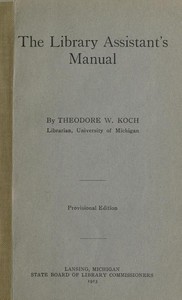
The Library Assistant's Manual
Written by Theodore Wesley Koch
Chaptra reads alongside you — AI insights, chapter breakdowns and reader discussions for every book. Join free
About this book
Reading guide
Themes, characters and key ideas in The Library Assistant's Manual, written by Chaptra AI.
- about 10 hours
- intermediate
- informative
- instructive
- historical
Theodore W. Koch's "The Library Assistant's Manual" is a seminal early 20th-century guide designed to equip library assistants with the foundational knowledge and practical skills required for effective library operations. It comprehensively details the organizational, pedagogical, and service-oriented aspects of library management, contextualizing these practices within the historical evolution of public libraries in the United States. From the genesis of subscription libraries to the emergence of accessible public institutions, the manual traces the philosophical underpinnings of librarianship, emphasizing systematic organization, efficient patron service, and the evolving role of libraries in education and community engagement. This work serves as both a practical instruction set and a historical document, illuminating the professionalization of library science during a pivotal era.
“The evolution of the public library in America represents a profound commitment to the democratization of knowledge and culture.”
Key themes
- Democratization of Knowledge and Public Service
- A foundational theme is the library's role as a democratic institution, providing free and equitable access to information and culture for all segments of society. The manual traces the historical shift from exclusive subscription libraries to inclusive public libraries, underscoring the commitment to serving diverse demographics, including children and educational institutions, as a civic duty.
- Professionalization of Librarianship
- The manual implicitly and explicitly champions the transformation of library work from a casual occupation into a structured, skilled profession. It details systematic methodologies for various tasks, emphasizing the need for specialized knowledge and training for library assistants, thereby contributing to the establishment of librarianship as a respected field with defined practices and roles.
- Systematic Organization and Efficiency
- Koch places immense value on meticulous organization as the cornerstone of effective library management. This theme permeates the entire manual, from classification and cataloging methods to the layout of the library and the structuring of staff roles. The underlying philosophy is that a well-ordered system directly translates to enhanced user experience and efficient information retrieval.
Worth discussing
How do the historical developments of public libraries discussed in the manual resonate with contemporary challenges in library funding and accessibility?
Chapter-by-chapter breakdowns, character arcs and the full thematic analysis come with a free account.
Discussions
No one has started one yet
Questions this book opens up
No discussions yet
Be the first to start a discussion about this book!
Sign up to start the discussionReviews
No reviews yet
Be the first to review this book!