
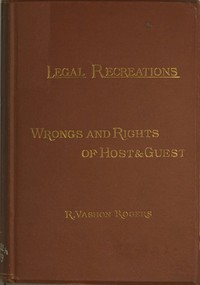
The Law of Hotel Life; or, the Wrongs and Rights of Host and Guest
Written by R. Vashon (Robert Vashon) Rogers
Chaptra reads alongside you — AI insights, chapter breakdowns and reader discussions for every book. Join free
About this book
Reading guide
Themes, characters and key ideas in The Law of Hotel Life; or, the Wrongs and Rights of Host and Guest, written by Chaptra AI.
- about 8 hours
- intermediate
- humorous
- ironic
- didactic
R. Vashon Rogers Jr.'s "The Law of Hotel Life" is a late 19th-century satirical narrative that humorously dissects the intricate, often absurd, world of hospitality laws through the eyes of a newlywed couple on their honeymoon. As they navigate a series of disappointing village inns, the lawyer-husband meticulously educates his wife on the historical and legal precedents governing host and guest interactions. The book cleverly uses their encounters with rude innkeepers and unsatisfactory conditions to highlight the ironic disparity between the theoretical 'rights' and 'wrongs' of hotel life and its frequently unpleasant practical realities, blending legal commentary with social satire and marital banter.
“It seems, my dear, that the ancient common law, in its wisdom, did not account for the modern innkeeper's peculiar brand of indifference.”
Key themes
- The Absurdity of Law vs. Reality
- This central theme explores the humorous and often frustrating disparity between the lofty, historically rooted legal principles governing hospitality and the often-grubby, indifferent reality of actual innkeeping. Rogers uses the husband's detailed legal explanations to highlight how the 'spirit' and 'letter' of the law are routinely disregarded in practice, creating a comedic tension that underscores the book's satirical intent.
- Hospitality and its Obligations
- The book delves into the historical and cultural understanding of hospitality, examining the reciprocal duties and expectations between host and guest. Rogers explores how these obligations, once deeply embedded in common law and social custom, have become eroded or commercialized in the late 19th century. The narrative implicitly argues for a return to or a recognition of these foundational principles.
- The Nature of Satire and Social Critique
- Rogers employs satire as a powerful tool to critique societal shortcomings. By exaggerating the unpleasantries of hotel life and juxtaposing them with the husband's dry legal explanations, the book exposes deeper issues of accountability, consumer vulnerability, and institutional indifference. The humor serves not just for entertainment but as a means to draw attention to real-world problems.
Worth discussing
How does Rogers use humor and satire to critique the legal and social aspects of hospitality in the late 19th century?
Chapter-by-chapter breakdowns, character arcs and the full thematic analysis come with a free account.
Discussions
No one has started one yet
Questions this book opens up
No discussions yet
Be the first to start a discussion about this book!
Sign up to start the discussionReviews
No reviews yet
Be the first to review this book!