
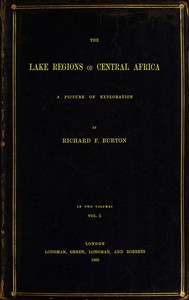
The Lake Regions of Central Africa: A Picture of Exploration, Vol. 1
Written by Richard Francis Burton
Chaptra reads alongside you — AI insights, chapter breakdowns and reader discussions for every book. Join free
About this book
Reading guide
Themes, characters and key ideas in The Lake Regions of Central Africa: A Picture of Exploration, Vol. 1, written by Chaptra AI.
- about 15 hours
- advanced
- exploratory
- challenging
- observational
Sir Richard Francis Burton's "The Lake Regions of Central Africa, Vol. 1" chronicles the initial leg of his perilous 1857-1859 expedition with John Hanning Speke into the unknown interior of East Africa, driven by the quest for the source of the Nile River. This volume meticulously details the arduous journey from Zanzibar to the central trading hub of Tabora, documenting the logistical challenges, the diverse landscapes, and the myriad cultures encountered. Burton, acting as both intrepid explorer and keen ethnographer, provides an exhaustive account of the geography, flora, fauna, and the social customs of the various tribes, all presented through the lens of a Victorian-era European adventurer. The book serves as a foundational text in the history of African exploration, offering a fascinating, albeit biased, glimpse into a continent on the cusp of intense colonial scrutiny.
“"The African is a being of extremes, a child in his passions, a man in his cunning, and a brute in his impulses."”
Key themes
- Exploration and Discovery
- This is the overarching theme, driven by the scientific imperative to map unknown territories and solve geographical mysteries, particularly the source of the Nile. Burton meticulously details the process of exploration, from logistical planning to the physical demands and the thrill of charting new lands. It's presented as a noble pursuit of knowledge, despite its inherent dangers.
- Colonialism and Empire
- While not explicitly a colonial treatise, the entire expedition operates within the burgeoning British imperial project. Burton's observations on trade, resources, and indigenous governance, coupled with his Eurocentric viewpoint, implicitly frame Africa as a territory ripe for European influence and exploitation. The 'civilizing mission' and economic opportunities are underlying motivations.
- Cultural Encounter and the 'Other'
- Burton, a keen observer and linguist, provides extensive accounts of the various African tribes encountered. However, these descriptions are consistently filtered through a Victorian, Eurocentric lens, portraying indigenous peoples as 'primitive,' 'savage,' or 'childlike.' This theme explores how the 'Other' is constructed and understood (or misunderstood) by the European gaze, often reinforcing existing prejudices.
Worth discussing
How does Burton's account reflect the prevailing attitudes of Victorian colonialism and racism? In what ways can we critically engage with such historical texts today?
Chapter-by-chapter breakdowns, character arcs and the full thematic analysis come with a free account.
Discussions
No one has started one yet
Questions this book opens up
No discussions yet
Be the first to start a discussion about this book!
Sign up to start the discussionReviews
No reviews yet
Be the first to review this book!