
Chaptra
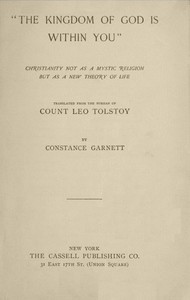
Cover of "The Kingdom of God Is Within You": Christianity Not as a Mystic Religion but as a New Theory of Life

"The Kingdom of God Is Within You": Christianity Not as a Mystic Religion but as a New Theory of Life

Written by Leo Tolstoy

Not rated yet — tap a star to review it

Chaptra reads alongside you — AI insights, chapter breakdowns and reader discussions for every book. Join free

About this book

"The Kingdom of God Is Within You" by graf Leo Tolstoy is a philosophical exploration written in the late 19th century. This work presents a thoughtful critique of established religion, particularly orthodox Christianity, while advocating for a practical application of Christ's teachings, especially the principle of non-resistance to evil by force. Tolstoy argues for a deeper understanding of Christianity as a radical and transformative way of life rather than a mere set of beliefs or rituals, suggesting that true Christian living leads to inner peace and the establishment of a just society. The opening of the book sets the stage for Tolstoy's examination of the doctrine of non-resistance to evil, emphasizing its significance throughout the history of Christianity. He references previous writings and discussions surrounding the concept, including letters from Quakers and the views of other historical figures who also championed non-resistance. Tolstoy notes societal reluctance to accept these ideas and identifies a general spiritual misunderstanding regarding the authentic teachings of Christ, indicating a continuous struggle to reconcile the call to non-violence with human institutions built on force and authority. Through this introduction, he aims to lay a foundation for a nuanced discussion of ethics, morality, and the essence of Christianity in the modern world.

Reading guide

Themes, characters and key ideas in "The Kingdom of God Is Within You": Christianity Not as a Mystic Religion but as a New Theory of Life, written by Chaptra AI.

  • about 12 hours
  • advanced
  • philosophical
  • challenging
  • provocative

Leo Tolstoy's "The Kingdom of God Is Within You" is a profound philosophical treatise that rigorously critiques institutionalized Christianity and state authority, advocating for a radical reinterpretation of Christ's teachings. Central to his argument is the principle of non-resistance to evil by force, which Tolstoy posits as the true essence of Christian living and the only path to genuine peace and justice. He argues that conventional churches and governments have betrayed this core tenet, leading to widespread suffering and moral corruption. The book challenges readers to embrace an inner, spiritual understanding of Christianity that transcends dogma and ritual, leading to individual moral transformation and ultimately, a non-violent, anarchistic society.

The Kingdom of God is within you, and not outside you.

Key themes

Non-Resistance to Evil by Force
This is the central tenet of Tolstoy's work. He argues that Christ's command to 'resist not evil' is a literal injunction, not a metaphorical one, and forms the bedrock of true Christian living. This principle demands a complete rejection of all forms of violence, coercion, and participation in institutions (like the state, military, or judiciary) that rely on force. Tolstoy believes that only through non-resistance can humanity break the cycle of violence and achieve genuine peace.
Critique of State and Church Authority
Tolstoy vehemently argues that both the state and the institutional church have fundamentally corrupted Christ's original message. He sees the state as an inherently violent entity, built on coercion and force, while the church, by allying itself with the state and sanctioning its violence, has betrayed its spiritual mission. This theme explores the hypocrisy and moral bankruptcy of these institutions in contrast to the radical purity of Christ's teachings.
True Christianity as a Way of Life
Tolstoy rejects the notion of Christianity as a mystic religion of rituals, dogmas, and external observances. Instead, he posits it as a radical, practical, and transformative 'theory of life' centered on individual moral action and the internal realization of God's law. This theme emphasizes personal responsibility, the development of conscience, and the consistent application of Christ's teachings (especially love and non-violence) in all aspects of daily existence.

Worth discussing

Is Tolstoy's interpretation of Christ's teachings on non-resistance practical or idealistic in today's world?

Chapter-by-chapter breakdowns, character arcs and the full thematic analysis come with a free account.

Discussions

No one has started one yet

Join

Questions this book opens up

No discussions yet

Be the first to start a discussion about this book!

Sign up to start the discussion

Reviews

No reviews yet

Be the first to review this book!