
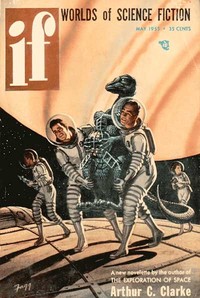
The Kenzie Report
Written by Mark Clifton
Chaptra reads alongside you — AI insights, chapter breakdowns and reader discussions for every book. Join free
About this book
Reading guide
Themes, characters and key ideas in The Kenzie Report, written by Chaptra AI.
- about 8 hours
- intermediate
- humorous
- thought-provoking
- mysterious
Mark Clifton's "The Kenzie Report" is an early to mid-20th-century science fiction story centered on the eccentric scientist Kenzie MacKenzie, who, with his colleague Pringle, endeavors to establish communication with ants. Their laboratory research into creating a relay device gradually uncovers profound and unsettling truths about intelligence and the limitations of human perception. The narrative culminates in a revelation that challenges human supremacy, suggesting ants possess a far more advanced, dominant intellect on Earth. Through a blend of humor and philosophical inquiry, the story prompts readers to re-evaluate humanity's assumed place in the universe and the true capabilities of other life forms.
“"We humans, Pringle, are so utterly convinced of our own unique brilliance that we rarely bother to look beyond our own antennae."”
Key themes
- Intelligence and Perception
- The core theme exploring the nature of intelligence beyond human-centric definitions and how human perception limits our understanding of other life forms. The story challenges the idea that intelligence must manifest in ways recognizable to humans (e.g., verbal language, complex tools).
- Human Supremacy and Hubris
- This theme directly critiques humanity's arrogant assumption of its position as the dominant, most intelligent species on Earth. The story functions as a powerful humbling experience, subverting this long-held belief.
- The Nature of Reality
- The story delves into how our understanding of reality is shaped by our sensory inputs and cognitive frameworks. It suggests that there might be vastly different, equally valid, or even superior realities co-existing with our own, unseen or unheard by us.
Worth discussing
How does Clifton use humor to make the profound philosophical questions of the story more palatable or impactful?
Chapter-by-chapter breakdowns, character arcs and the full thematic analysis come with a free account.
Discussions
No one has started one yet
Questions this book opens up
No discussions yet
Be the first to start a discussion about this book!
Sign up to start the discussionReviews
No reviews yet
Be the first to review this book!