
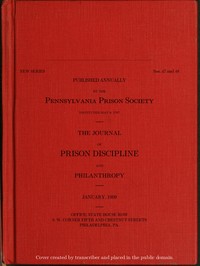
The Journal of Prison Discipline and Philanthropy (New Series, No. 47 and 48, January 1909)
Written by Pennsylvania Prison Society
Chaptra reads alongside you — AI insights, chapter breakdowns and reader discussions for every book. Join free
About this book
Reading guide
Themes, characters and key ideas in The Journal of Prison Discipline and Philanthropy (New Series, No. 47 and 48, January 1909), written by Chaptra AI.
- about 6 hours
- advanced
- informative
- advocacy
- serious
The Journal of Prison Discipline and Philanthropy (New Series, No. 47 and 48, January 1909) is a significant historical document published by the Pennsylvania Prison Society, serving as a vital record of early 20th-century discourse on penology and social reform. This particular issue likely compiles articles, reports, and discussions from leading thinkers and practitioners concerning the state of prisons, the efficacy of various disciplinary methods, and the philosophical underpinnings of criminal justice at the time. It reflects the ongoing efforts to humanize correctional institutions, advocate for rehabilitation over purely punitive measures, and address societal factors contributing to crime. The journal is an invaluable resource for understanding the historical evolution of prison reform movements in the United States.
“"The true measure of a society's civilization is found in its treatment of those incarcerated."”
Key themes
- Prison Reform and Humanitarianism
- This journal's central theme is the ongoing effort to reform the American prison system, driven by humanitarian concerns. It explores the moral imperative to treat inmates with dignity, improve living conditions, and implement practices that foster rehabilitation rather than solely punishment. This theme reflects a growing societal awareness of human rights, even for those convicted of crimes, and the belief that a just society must extend its compassion to all its members.
- Rehabilitation vs. Retribution
- A core tension explored within the journal is the philosophical debate between punishment as retribution for a crime and punishment as an opportunity for the offender's rehabilitation. The Pennsylvania Prison Society generally advocated for rehabilitation, emphasizing the potential for inmates to become productive members of society through education, vocational training, and moral guidance. This theme delves into the practical and ethical arguments for each approach and their implications for prison policy.
- Societal Responsibility and Crime Prevention
- The journal likely addresses the broader societal factors contributing to crime and the community's role in both preventing crime and supporting the reintegration of former inmates. This theme moves beyond the walls of the prison to consider issues like poverty, lack of education, and social inequality as root causes of criminal behavior, suggesting that true reform requires societal-level interventions. It highlights the philanthropic aspect of the society's work, extending beyond prison walls.
Worth discussing
How do the arguments for prison reform presented in 1909 compare to contemporary debates about criminal justice?
Chapter-by-chapter breakdowns, character arcs and the full thematic analysis come with a free account.
Discussions
No one has started one yet
Questions this book opens up
No discussions yet
Be the first to start a discussion about this book!
Sign up to start the discussionReviews
No reviews yet
Be the first to review this book!