
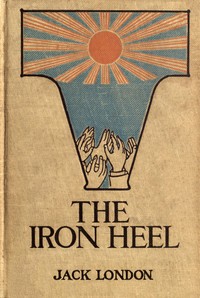
The iron heel
Written by Jack London
Chaptra reads alongside you — AI insights, chapter breakdowns and reader discussions for every book. Join free
About this book
Reading guide
Themes, characters and key ideas in The iron heel, written by Chaptra AI.
- about 8 hours
- advanced
- dystopian
- polemical
- bleak
Jack London's "The Iron Heel" is a prescient dystopian novel framed as a historical document from a future socialist age, detailing the rise of a brutal capitalist oligarchy in early 20th-century America. Narrated by Avis Everhard, the wife of socialist leader Ernest Everhard, the story chronicles their struggle against the burgeoning power of the "Iron Heel," a coalition of wealthy industrialists who crush labor movements and establish a totalitarian regime. The novel vividly depicts the violent suppression of dissent, the desperation of the working class, and the intellectual and physical battles waged by revolutionaries, culminating in the tragic defeat of open rebellion and the establishment of a long-lasting, oppressive system. It serves as a stark warning against unchecked corporate power and a passionate, if ultimately bleak, call for social justice.
“"The Iron Heel! It is there, I tell you! It has been there for a dozen years, and you have not seen it. It is the Oligarchy, and it is here to stay."”
Key themes
- Class Struggle and Socialism vs. Capitalism
- This is the central, overarching theme of the novel. London vividly portrays the irreconcilable conflict between the working class (proletariat) and the capitalist owners (bourgeoisie/oligarchy). Through Ernest's speeches and the narrative's events, the book argues for the inherent injustices of capitalism and advocates for a socialist revolution as the only path to genuine equality and freedom.
- The Nature of Power and Oligarchy
- London explores how power is seized, consolidated, and maintained by a ruthless elite. The novel details the mechanisms of an oligarchy: control over media, manipulation of laws, creation of private armies, and the systematic suppression of dissent. It suggests that once power is absolute, it becomes self-perpetuating and corrupting, leading to tyranny.
- Revolution and Resistance
- The novel grapples with the necessity, methods, and ultimately, the costs of revolutionary struggle against an entrenched oppressive system. It portrays both the intellectual arguments for revolution and the brutal realities of armed conflict, questioning whether violence is an inevitable or effective path to social change.
Worth discussing
To what extent were Jack London's predictions about the rise of an oligarchy accurate in the 20th and 21st centuries?
Chapter-by-chapter breakdowns, character arcs and the full thematic analysis come with a free account.
Discussions
No one has started one yet
Questions this book opens up
No discussions yet
Be the first to start a discussion about this book!
Sign up to start the discussionReviews
No reviews yet
Be the first to review this book!