
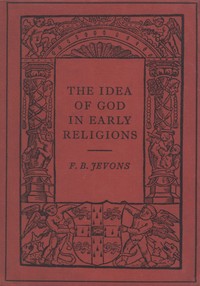
The Idea of God in Early Religions
Written by F. B. (Frank Byron) Jevons
Chaptra reads alongside you — AI insights, chapter breakdowns and reader discussions for every book. Join free
About this book
Reading guide
Themes, characters and key ideas in The Idea of God in Early Religions, written by Chaptra AI.
- about 12 hours
- advanced
- scholarly
- analytical
- historical
F. B. Jevons's "The Idea of God in Early Religions" is a foundational early 20th-century academic work that investigates the genesis and evolution of the concept of divinity in primitive societies. It meticulously distinguishes between early forms of reverence, such as fetishism, and more developed notions of a god, positing that the latter emerges concurrently with a community's awareness of its collective welfare and an individual's self-consciousness. Jevons explores how societal structures, communication, and inherited beliefs shape an individual's understanding of higher powers, moving beyond simplistic explanations to analyze the social and emotional underpinnings of worship. The book ultimately seeks to trace the development of religious consciousness from its most rudimentary expressions to more complex polytheistic systems, laying groundwork for understanding the philosophical roots of religious practice.
“"Individuals are born into a community with pre-existing beliefs and social constructs; it is within this framework that the idea of higher powers begins to take shape."”
Key themes
- Evolution of Religious Consciousness
- This theme is central to Jevons's work, exploring the progression of human understanding of the divine from rudimentary forms (like fetishism) to more complex, community-centric concepts of a god. He posits that religious thought is not static but develops alongside human social and psychological evolution.
- Distinction between Fetishism and Theism
- A core analytical framework of the book, this theme rigorously differentiates between the veneration of objects imbued with impersonal power (fetishism) and the recognition of a personal or suprapersonal deity with agency and a relationship to the community (theism). This distinction is crucial for Jevons's evolutionary model of religious thought.
- Social Construction of Divinity
- Jevons emphasizes that concepts of higher powers are not purely individual revelations but are deeply embedded in and shaped by societal structures, pre-existing beliefs, and communal communication. The divine is understood as a product of collective experience and shared meaning-making.
Worth discussing
How does Jevons's argument about the relationship between individual self-awareness and the concept of a community-oriented god resonate with or diverge from modern psychological theories of religion?
Chapter-by-chapter breakdowns, character arcs and the full thematic analysis come with a free account.
Discussions
No one has started one yet
Questions this book opens up
No discussions yet
Be the first to start a discussion about this book!
Sign up to start the discussionReviews
No reviews yet
Be the first to review this book!