
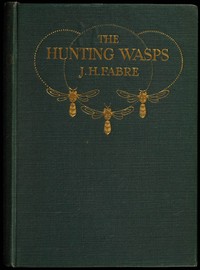
The Hunting Wasps
Written by Jean-Henri Fabre
Chaptra reads alongside you — AI insights, chapter breakdowns and reader discussions for every book. Join free
About this book
Read it with a club
Small groups reading the same books and talking as they go.


News
- 4 members
- 1,813 discussions
- Active Sep 11
Read The Hunting Wasps alongside people who are reading it too.
Also here: News Bulletin, Just Joking....
Chaptra Prime — paid clubs, every club feature, and unlimited reading support, for $5 a month or $60 once.
See PrimeReading guide
Themes, characters and key ideas in The Hunting Wasps, written by Chaptra AI.
- about 8 hours
- intermediate
- observational
- scientific
- wondrous
Jean-Henri Fabre's "The Hunting Wasps" is a seminal late 19th-century scientific work that meticulously documents the lives and predatory behaviors of various wasp species. Through years of patient, detailed observation, Fabre unveils the astonishing instincts governing these insects' hunting techniques, paralysis methods, and the sophisticated provisioning of their young. The book serves as both a scientific treatise and a compelling narrative, exploring the intricate ecological relationships and the profound intelligence inherent in nature's design. It begins with Fabre's personal journey into entomology, inspired by Léon Dufour, and quickly immerses the reader in the fascinating world of wasps like the Cerceris, demonstrating how seemingly simple creatures execute complex, almost scientific, strategies for survival.
“The insect, humble as it seems, holds within its tiny frame a universe of wonders, a testament to the grand designs of nature.”
Key themes
- Instinct vs. Intelligence
- This is the central philosophical question Fabre grapples with throughout the book. He meticulously details the wasps' complex behaviors—hunting, nest building, provisioning—and questions whether these are purely unlearned, inherited instincts, or if there's any element of conscious thought, adaptation, or learning involved. His observations often highlight the astonishing perfection of instinct, but also its rigid, sometimes illogical, limitations when confronted with novel situations.
- The Complexity and Interconnectedness of Nature
- Fabre's detailed observations reveal the intricate web of life, where each creature plays a specific role. The hunting wasps are not isolated entities but are deeply integrated into their ecosystem through their predator-prey relationships, their specific choice of prey, and their contribution to nutrient cycles. The book highlights how seemingly small actions by insects contribute to a larger, complex, and balanced natural order.
- The Scientific Method and Observation
- The book is a testament to the power of empirical observation and patient scientific inquiry. Fabre's methodology—spending countless hours in the field, meticulously documenting behaviors, designing simple yet effective experiments, and drawing conclusions based on direct evidence—is a central theme. It champions a hands-on, experiential approach to understanding the natural world, often contrasting with purely theoretical or laboratory-based science.
Worth discussing
To what extent does Fabre's work suggest that insect behavior is purely instinctive, and where does he hint at rudimentary intelligence or adaptability?
Chapter-by-chapter breakdowns, character arcs and the full thematic analysis come with a free account.
Discussions
No one has started one yet
Questions this book opens up
No discussions yet
Be the first to start a discussion about this book!
Sign up to start the discussionReviews
No reviews yet
Be the first to review this book!