
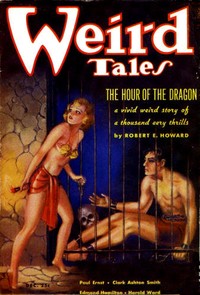
The Hour of the Dragon
Written by Robert E. (Robert Ervin) Howard
Chaptra reads alongside you — AI insights, chapter breakdowns and reader discussions for every book. Join free
About this book
Reading guide
Themes, characters and key ideas in The Hour of the Dragon, written by Chaptra AI.
- about 8 hours
- intermediate
- epic
- dark
- adventurous
Robert E. Howard's "The Hour of the Dragon" is an epic sword & sorcery novel that plunges Conan the Cimmerian, now King of Aquilonia, into a grand struggle against an ancient, resurrected evil. Stripped of his throne by the sorcerers who revived the Stygian wizard Xaltotun, Conan embarks on a perilous quest across the Hyborian Age to retrieve the mythical Heart of Ahriman, the only artifact capable of defeating his magical foe. The narrative weaves together political conspiracy, dark sorcery, and relentless action, showcasing Conan's barbarian might and cunning against forces that threaten to engulf the entire world. It is a quintessential tale of heroism, betrayal, and the enduring conflict between primal strength and arcane power.
“Hither came Conan, the Cimmerian, black-haired, sullen-eyed, sword in hand, a thief, a reaver, a slayer, with gigantic melancholies and gigantic mirth, to tread the jeweled thrones of the Earth under his sandaled feet.”
Key themes
- Civilization vs. Barbarism
- This central Howardian theme explores the inherent tension between the 'decadent' and 'corrupt' nature of advanced civilizations and the 'primal vitality' and 'raw strength' of barbarism. Conan, a barbarian king, embodies this conflict, often proving more honorable and effective than the 'civilized' rulers and sorcerers he encounters. The story suggests that civilization, while offering order, also breeds weakness, intrigue, and the potential for greater evils.
- The Nature of Power and Corruption
- The novel meticulously examines different forms of power – political, magical, and physical – and how they can corrupt or be wielded for good. Xaltotun represents the ultimate corruption of magical power, seeking absolute dominion. The various kings and sorcerers demonstrate how ambition and weakness lead to betrayal and subjugation. Conan, in contrast, uses his physical and strategic power with a sense of justice, though not without his own ruthless streak.
- Ancient Evils and the Persistence of the Past
- Howard frequently highlights the idea that the past is never truly dead, and ancient, forgotten evils can resurface to plague the present. Xaltotun, mummified for centuries, and the Heart of Ahriman, an artifact from a bygone age, are prime examples. The story emphasizes that despite the rise and fall of civilizations, certain malevolent forces endure, requiring vigilance and courage to combat.
Worth discussing
How does Howard portray the conflict between 'civilization' and 'barbarism' through Conan's character and the Hyborian world? Is his perspective still relevant today?
Chapter-by-chapter breakdowns, character arcs and the full thematic analysis come with a free account.
Discussions
No one has started one yet
Questions this book opens up
No discussions yet
Be the first to start a discussion about this book!
Sign up to start the discussionReviews
No reviews yet
Be the first to review this book!