
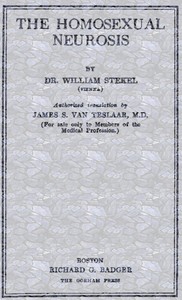
The Homosexual Neurosis
Written by Wilhelm Stekel
Chaptra reads alongside you — AI insights, chapter breakdowns and reader discussions for every book. Join free
About this book
Reading guide
Themes, characters and key ideas in The Homosexual Neurosis, written by Chaptra AI.
- about 12 hours
- advanced
- academic
- clinical
- controversial
Wilhelm Stekel's "The Homosexual Neurosis" is an early 20th-century psychoanalytic work that endeavors to classify and explain homosexuality through a Freudian lens, positing it as a neurotic condition rooted in complex psychological dynamics. The book explores factors such as familial relationships, individual experiences, and the development of sexual attraction, often framing aversion to the opposite sex as a core component. It builds upon contemporary discussions of bisexuality and autoerotism, utilizing clinical studies to delineate the supposed neurological or emotional underpinnings of homosexual behavior. The text, introduced by a translator's preface emphasizing its Freudian foundation, aims to provide a comprehensive clinical evaluation of what was then considered a psychological disorder, influencing early understandings of sexual orientation.
“"Homosexuality, in its essence, represents a neurotic flight from the opposite sex, often rooted in unresolved infantile complexes."”
Key themes
- The Neurotic Basis of Homosexuality
- This is the central theme, forming the very premise and title of the book. Stekel argues that homosexuality is not an innate orientation but a psychological neurosis, a deviation from 'normal' development caused by unresolved conflicts, traumas, or fixations. He meticulously details various psychological mechanisms, such as a 'flight from the opposite sex' or an 'Oedipal fixation,' as root causes, aiming to provide a comprehensive explanation for its supposed genesis.
- Familial Dynamics and Early Childhood Experiences
- Stekel, following Freudian principles, places significant emphasis on the formative influence of early childhood and family relationships. The book explores how parental figures (e.g., dominant mothers, absent fathers), sibling dynamics, and early traumatic experiences contribute to the development of sexual preference and the supposed 'neurosis.' These factors are presented as crucial in shaping an individual's psychological landscape and their eventual sexual orientation.
- The Psychoanalytic Method
- The book itself is a demonstration of the early psychoanalytic method in action. It showcases the systematic application of Freudian theories – including concepts like the unconscious, repression, dream analysis (implicitly), and transference – to understand and 'treat' psychological conditions. Stekel's approach involves detailed clinical interviews, interpretation of patient narratives, and the construction of theoretical frameworks to explain observed behaviors, all within the nascent field of psychoanalysis.
Worth discussing
How does Stekel's work reflect the prevailing scientific and societal attitudes towards homosexuality in the early 20th century?
Chapter-by-chapter breakdowns, character arcs and the full thematic analysis come with a free account.
Discussions
No one has started one yet
Questions this book opens up
No discussions yet
Be the first to start a discussion about this book!
Sign up to start the discussionReviews
No reviews yet
Be the first to review this book!