
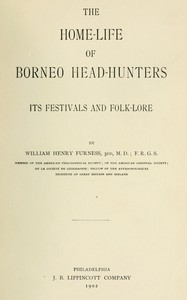
The home-life of Borneo head-hunters : $b Its festivals and folk-lore
Written by William Henry Furness
Chaptra reads alongside you — AI insights, chapter breakdowns and reader discussions for every book. Join free
About this book
Reading guide
Themes, characters and key ideas in The home-life of Borneo head-hunters : $b Its festivals and folk-lore, written by Chaptra AI.
- about 8 hours
- intermediate
- observational
- ethnographic
- historical
William Henry Furness, 3rd's "The Home-Life of Borneo Head-Hunters" is an early 20th-century ethnographic study offering an intimate look into the daily lives, traditions, and intricate social structures of the Kayan and Kenyah tribes of Borneo. Despite their fearsome reputation, Furness portrays these communities with deep admiration, detailing their communal longhouse living, family dynamics, and rich tapestry of festivals and folklore. The work highlights the contrast between external perceptions and the complex reality of indigenous life, serving as a crucial historical document of their cultural practices and spiritual beliefs. Furness, through a blend of scientific observation and personal reflection, seeks to humanize the 'other' while inadvertently reflecting the paternalistic undertones common to anthropology of his era.
“Despite their fearsome reputation, I found among the Kayan a profound sense of community and an intricate tapestry of daily life that belied any simple notion of savagery.”
Key themes
- Ethnographic Observation and Cultural Understanding
- This is the core theme, exploring the challenges and rewards inherent in documenting and interpreting an unfamiliar culture. Furness attempts to bridge cultural gaps through meticulous observation and detailed description, striving to present a nuanced understanding of the Kayan and Kenyah tribes to a Western audience.
- The Clash of Perceptions: 'Savage' vs. 'Civilized'
- Furness directly addresses the prevailing Western perception of the Borneo tribes as brutal head-hunters, contrasting this with the intricate, communal, and often admirable daily life he observes. The theme explores how external reputations can obscure the complex realities of a culture.
- Tradition, Folklore, and Spiritual Beliefs
- The book delves deeply into the superstitions, myths, and rituals that form the bedrock of the Kayan and Kenyah worldview. This theme highlights how these elements are not mere quaint customs but are integral to daily life, social cohesion, and the tribes' understanding of the natural and supernatural worlds.
Worth discussing
How does Furness challenge or reinforce prevailing Western stereotypes of 'savage' cultures in his portrayal of the Kayan and Kenyah tribes?
Chapter-by-chapter breakdowns, character arcs and the full thematic analysis come with a free account.
Discussions
No one has started one yet
Questions this book opens up
No discussions yet
Be the first to start a discussion about this book!
Sign up to start the discussionReviews
No reviews yet
Be the first to review this book!