
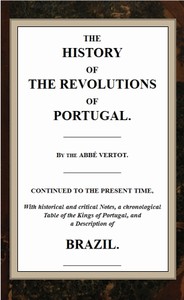
The History of the Revolutions of Portugal
Written by abbé de Vertot,Pierre Marie Louis de Boisgelin de Kerdu
Chaptra reads alongside you — AI insights, chapter breakdowns and reader discussions for every book. Join free
About this book
Reading guide
Themes, characters and key ideas in The History of the Revolutions of Portugal, written by Chaptra AI.
- about 15 hours
- advanced
- Informative
- Historical
- Serious
''The History of the Revolutions of Portugal'' by Abbé Vertot and Louis de Boisgelin de Kerdu is an early 19th-century historical account detailing the tumultuous power shifts and dynastic struggles within Portugal. The work traces the kingdom's origins from its initial resistance against Moorish conquest to its establishment under Count Henry of Burgundy, emphasizing the complex interplay between rulers, ministers, and societal forces. It serves as an educational text, highlighting the geopolitical landscape and the impact of both internal ambitions and foreign influences on Portugal's evolving monarchy. Through an engaging narrative, the authors introduce readers to the significant historical events that shaped the Portuguese state, making it relevant for understanding modern historical dynamics. The book underscores the importance of historical education and provides a comprehensive look at the foundation and transformation of a European nation.
“The history of nations is but a chronicle of their struggles for identity, a relentless dance between internal ambition and external pressure.”
Key themes
- Power and Succession
- This is the central theme, exploring the mechanisms by which power is gained, lost, and transferred within the Portuguese monarchy. It delves into the legitimacy of rulers, the challenges of dynastic lines, and the constant struggle to maintain control amidst internal rivalries and external pressures. The 'revolutions' are direct manifestations of these power struggles.
- National Identity and Sovereignty
- The book examines how Portugal's identity as an independent nation-state was forged through centuries of struggle. It highlights the continuous effort to assert sovereignty against foreign invaders (Moorish, Castilian) and maintain cultural distinctiveness. The 'revolutions' are often depicted as moments where the nation either affirmed or risked losing its unique identity.
- Foreign Influence and Intervention
- This theme explores the significant impact of external powers, particularly neighboring kingdoms and larger European empires, on Portugal's internal affairs and political stability. It details how foreign alliances, rivalries, and direct interventions often triggered or exacerbated the 'revolutions' and shaped the course of Portuguese history.
Worth discussing
How do the authors define 'revolution' within the context of 19th-century historical writing, and how does this compare to modern interpretations?
Chapter-by-chapter breakdowns, character arcs and the full thematic analysis come with a free account.
Discussions
No one has started one yet
Questions this book opens up
No discussions yet
Be the first to start a discussion about this book!
Sign up to start the discussionReviews
No reviews yet
Be the first to review this book!