
About this book
Reading guide
Themes, characters and key ideas in The History of the Reformation of Religion in Scotland: With Which Are Included Knox's Confession and The Book of Discipline, written by Chaptra AI.
- about 15 hours
- advanced
- Zealous
- Historical
- Polemical
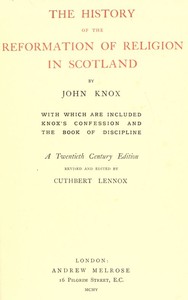
John Knox's "The History of the Reformation of Religion in Scotland" is a seminal mid-16th century account chronicling the tumultuous birth of Protestantism in Scotland. Written from Knox's fervent, firsthand perspective, the work details the struggle against the entrenched authority of the Catholic Church, beginning with the early persecutions and martyrdoms that ignited the reformist spirit. It meticulously records the rise of dissenting voices, the political machinations, and the civil unrest that ultimately led to the establishment of the Presbyterian Kirk. More than a historical record, it stands as a passionate manifesto for religious freedom and the divine right to pursue spiritual truth, profoundly shaping Scotland's religious and national identity.
“One mass is more fearful to me than if ten thousand armed enemies were landed in any part of the realm, of purpose to suppress the whole religion.”
Key themes
- Religious Persecution and Martyrdom
- Knox vividly details the systematic persecution, torture, and execution of early Protestant reformers by the Catholic hierarchy. These accounts, particularly of figures like Patrick Hamilton and George Wishart, serve as powerful justifications for the subsequent rebellion, portraying the Catholic Church as a tyrannical and bloodthirsty institution. The martyrs' steadfastness in faith becomes a source of inspiration and a testament to the divine truth of their cause.
- The Struggle for Religious Freedom
- This is the overarching driving force of the entire narrative. Knox frames the Scottish Reformation as a righteous battle for the right to worship God according to His 'pure Word,' free from the 'idolatry' and 'superstition' of the Catholic Church. It's presented as a quest for national spiritual liberation, asserting the supremacy of individual conscience and Scriptural authority over ecclesiastical tradition and papal decrees.
- Divine Providence and God's Will
- Knox interprets all historical events, whether triumphs or setbacks, through the lens of God's direct intervention and overarching plan. The success of the Reformation is seen as divine favor, while obstacles are tests of faith or divine judgments on human sin. This theological framework provides the narrative with its moral authority, unwavering conviction, and an almost prophetic tone, asserting that God is actively working through the reformers.
Worth discussing
How does Knox's personal involvement and bias affect the historical reliability of his account? Can a partisan history still be considered valuable?
Chapter-by-chapter breakdowns, character arcs and the full thematic analysis come with a free account.
Discussions
No one has started one yet
Questions this book opens up
No discussions yet
Be the first to start a discussion about this book!
Sign up to start the discussionReviews
No reviews yet
Be the first to review this book!