
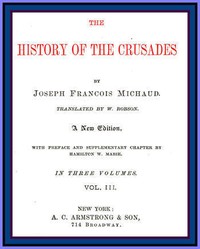
The History of the Crusades (vol. 3 of 3)
Written by J. Fr. (Joseph Fr.) Michaud
Chaptra reads alongside you — AI insights, chapter breakdowns and reader discussions for every book. Join free
About this book
Read it with a club
Small groups reading the same books and talking as they go.


News
- 4 members
- 1,813 discussions
- Active Sep 11
Read The History of the Crusades (vol. 3 of 3) alongside people who are reading it too.
Also here: News Bulletin, Just Joking....
Chaptra Prime — paid clubs, every club feature, and unlimited reading support, for $5 a month or $60 once.
See PrimeReading guide
Themes, characters and key ideas in The History of the Crusades (vol. 3 of 3), written by Chaptra AI.
- about 8 hours
- advanced
- historical
- tumultuous
- desperate
Joseph François Michaud's 'The History of the Crusades (vol. 3 of 3)' meticulously chronicles the decline and eventual end of the Crusader states, spanning from A.D. 1255 to 1396. This volume details the period following Louis IX's ambitious but ultimately unsuccessful efforts to secure Christian strongholds in Palestine. It vividly portrays the internal strife among Christian factions, particularly the devastating conflicts between Genoa and Venice, which severely undermined their collective strength against a resurgent Muslim front. The narrative culminates in the rise of the Mamelukes, their strategic confrontations with the Mongols, and the complex web of alliances and betrayals that shaped the fate of the Levant, highlighting the desperation and ultimate failure of the Crusading ideal in its final stages.
“"The very zeal that had once bound them together now rent them asunder, a fatal discord in the face of a common enemy."”
Key themes
- The Perils of Disunity
- Michaud extensively details how internal conflicts, particularly between Genoa and Venice, and among various Christian noble factions, fatally undermined the Crusader states' ability to resist external threats. This theme highlights that even a common enemy cannot unite a deeply fractured populace.
- The Decline of an Ideal
- The volume chronicles the gradual erosion of the initial religious fervor and grand objectives of the Crusades. As military failures mount and internal conflicts persist, the ideal of liberating the Holy Land gives way to pragmatic concerns, disillusionment, and eventual abandonment by European powers.
- The Struggle for Power and Empire
- Beyond religious conflict, the book meticulously details the relentless struggle for territorial control, economic dominance, and political supremacy among various factions—Christian, Muslim, and Mongol. This highlights the underlying realpolitik driving many of the era's events.
Worth discussing
How does Michaud's 19th-century perspective influence his portrayal of the Crusades, particularly concerning Christian and Muslim motivations?
Chapter-by-chapter breakdowns, character arcs and the full thematic analysis come with a free account.
Discussions
No one has started one yet
Questions this book opens up
No discussions yet
Be the first to start a discussion about this book!
Sign up to start the discussionReviews
No reviews yet
Be the first to review this book!