
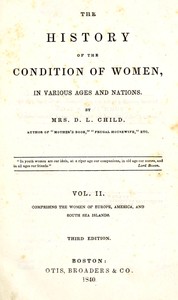
The history of the condition of women, in various ages and nations (vol. 2 of 2) : $b Comprising the women of Europe, America, and South Sea Islands
Written by Lydia Maria Child
Chaptra reads alongside you — AI insights, chapter breakdowns and reader discussions for every book. Join free
About this book
Reading guide
Themes, characters and key ideas in The history of the condition of women, in various ages and nations (vol. 2 of 2) : $b Comprising the women of Europe, America, and South Sea Islands, written by Chaptra AI.
- about 8 hours
- advanced
- Informative
- Analytical
- Critical
Lydia Maria Child's "The History of the Condition of Women, in Various Ages and Nations (Vol. 2)" offers a pivotal early 19th-century historical and sociological examination of women's status across diverse global societies. This volume systematically explores the lives, roles, and societal constraints placed upon women in regions spanning Europe, America, and the South Sea Islands, commencing with a detailed analysis of ancient Greece. Child meticulously documents the patriarchal customs, laws, and expectations that governed women's existence, highlighting both the systemic injustices and occasional instances of female agency. The work serves as a foundational text in early feminist thought, aiming to illuminate historical oppression and implicitly advocate for women's rights and equality.
“"The history of woman, in all ages and nations, is a melancholy record of injustice and suffering."”
Key themes
- The Oppression of Women
- This is the central theme, meticulously explored through historical accounts of legal, social, and cultural restrictions placed upon women across various ages and nations. Child details how women were denied education, political rights, economic autonomy, and often confined to domestic roles, highlighting the systemic nature of their subjugation.
- Patriarchy and Social Structures
- Child examines how patriarchal systems, rooted in male dominance, were institutionalized through laws, religious doctrines, cultural norms, and economic structures. She illustrates how these systems dictated women's roles, limited their agency, and perpetuated inequality across diverse societies.
- Advocacy for Equality and Reform
- Although an historical account, the book carries a strong implicit and often explicit undercurrent of advocacy. Child's detailed exposure of historical injustices serves as a powerful argument for the necessity of social, legal, and educational reforms to achieve gender equality, positioning the work as a foundational text for women's rights movements.
Worth discussing
How does Child's analysis of women's condition in ancient Greece resonate with or differ from modern historical understandings?
Chapter-by-chapter breakdowns, character arcs and the full thematic analysis come with a free account.
Discussions
No one has started one yet
Questions this book opens up
No discussions yet
Be the first to start a discussion about this book!
Sign up to start the discussionReviews
No reviews yet
Be the first to review this book!