
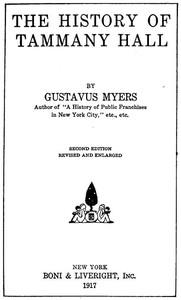
The History of Tammany Hall: Second Edition
Written by Gustavus Myers
Chaptra reads alongside you — AI insights, chapter breakdowns and reader discussions for every book. Join free
About this book
Reading guide
Themes, characters and key ideas in The History of Tammany Hall: Second Edition, written by Chaptra AI.
- about 8 hours
- advanced
- informative
- analytical
- critical
Gustavus Myers's "The History of Tammany Hall" offers a meticulous and critical examination of one of America's most enduring and controversial political organizations. From its founding in 1789 as a populist society advocating for equality, the book traces Tammany's evolution into a formidable political machine synonymous with urban corruption and patronage. Myers meticulously details the key figures, scandalous practices, and profound influence Tammany Hall exerted on New York City's governance and national politics. The narrative highlights the complex interplay between democratic ideals, the demands of a growing immigrant population, and the ruthless pursuit of power, ultimately revealing the systemic nature of political graft and its lasting legacy.
“"The very foundations of popular government were shaken by the audacious and systematic plundering which Tammany Hall had perfected."”
Key themes
- Political Corruption and Graft
- This is the central theme, meticulously explored through countless examples of electoral fraud, patronage, kickbacks, and the systematic siphoning of public funds. Myers details how corruption became institutionalized within Tammany Hall, transforming it from an occasional vice into a fundamental operating principle for decades.
- The Nature of Power and Leadership
- Myers examines how power is gained, consolidated, and maintained by individuals and organizations. The book illustrates the charismatic appeal and ruthless efficiency of Tammany bosses like Tweed, and how they built vast networks of loyalty and control, often by exploiting existing social structures and human needs.
- Democracy vs. Machine Politics
- Myers consistently contrasts the democratic ideals upon which the Tammany Society was supposedly founded with the reality of its evolution into an anti-democratic political machine. The book explores the tension between genuine popular representation and the manipulation of the democratic process for partisan gain, highlighting the fragility of democratic institutions when confronted by organized corruption.
Worth discussing
How did Tammany Hall, despite its corruption, manage to maintain power for so long? What lessons does this offer about political engagement?
Chapter-by-chapter breakdowns, character arcs and the full thematic analysis come with a free account.
Discussions
No one has started one yet
Questions this book opens up
No discussions yet
Be the first to start a discussion about this book!
Sign up to start the discussionReviews
No reviews yet
Be the first to review this book!