
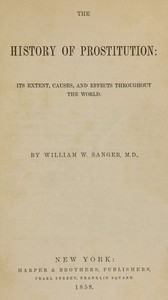
The History of Prostitution: Its Extent, Causes, and Effects throughout the World
Written by William W. Sanger
Chaptra reads alongside you — AI insights, chapter breakdowns and reader discussions for every book. Join free
About this book
Reading guide
Themes, characters and key ideas in The History of Prostitution: Its Extent, Causes, and Effects throughout the World, written by Chaptra AI.
- about 15 hours
- advanced
- informative
- somber
- critical
William W. Sanger's "The History of Prostitution" is a groundbreaking 19th-century medical and sociological treatise that meticulously explores the phenomenon of prostitution across historical eras and global societies. Sanger, an M.D., critiques society's reluctance to confront this pervasive issue, arguing for an open and scientific examination of its origins, evolution, and social impact. The work spans from ancient civilizations, detailing customs and legislation, to contemporary practices, aiming to understand the underlying causes and persistent nature of prostitution. Ultimately, Sanger seeks to provoke public discourse and inspire informed solutions to what he identifies as a significant societal affliction. It stands as a pivotal historical document reflecting 19th-century perspectives on public health, morality, and social reform.
“"To ignore the evil of prostitution is not to eradicate it, but to condemn society to perpetual ignorance of its roots and its devastating consequences."”
Key themes
- Social Critique and Reform
- Sanger explicitly positions his work as a critique of society's tendency to ignore or superficially condemn prostitution without addressing its underlying causes. He advocates for open discussion and informed solutions, reflecting a broader 19th-century reformist zeal that sought to apply scientific and rational approaches to social problems. The book is a call to action for societal introspection and systemic change.
- Historical Continuity and Universality of Prostitution
- A core tenet of Sanger's analysis is the demonstration that prostitution is not a modern anomaly but a persistent feature of human civilization across all historical epochs and geographical locations. By tracing its presence from ancient Jewish customs to contemporary practices, he establishes its deep roots in human society and culture, suggesting it's a deeply embedded, rather than transient, phenomenon.
- Factors Contributing to Prostitution (Poverty, Gender, Social Neglect)
- Sanger delves into the 'causes' of prostitution, which, for a 19th-century observer, would likely include economic hardship, lack of opportunities for women, societal double standards, and the general neglect of vulnerable populations. While his analysis would be limited by the social science of his era, it represents an early attempt to understand the systemic forces at play, rather than solely blaming individual moral failings.
Worth discussing
How does Sanger's 19th-century medical perspective influence his analysis of prostitution, and what are the limitations or insights gained from this viewpoint?
Chapter-by-chapter breakdowns, character arcs and the full thematic analysis come with a free account.
Discussions
No one has started one yet
Questions this book opens up
No discussions yet
Be the first to start a discussion about this book!
Sign up to start the discussionReviews
No reviews yet
Be the first to review this book!