
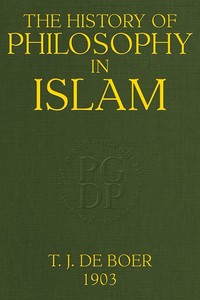
The History of Philosophy in Islam
Written by T. J. de (Tjitze J.) Boer
Chaptra reads alongside you — AI insights, chapter breakdowns and reader discussions for every book. Join free
About this book
Reading guide
Themes, characters and key ideas in The History of Philosophy in Islam, written by Chaptra AI.
- about 8 hours
- advanced
- Informative
- Academic
- Analytical
T. J. de Boer's "The History of Philosophy in Islam" is a foundational early 20th-century work that meticulously chronicles the trajectory of philosophical thought within Islamic civilization. It traces the origins of Islamic philosophy from its initial encounters with ancient Greek, Persian, and Indian wisdom, through its flourishing under various caliphates, to its eventual evolution and integration with theological discourse. The book highlights the critical interplay between Hellenistic intellectual traditions and Islamic religious frameworks, showcasing how prominent scholars synthesized, adapted, and expanded upon inherited philosophical concepts. De Boer's work serves as a comprehensive historical overview, mapping the intellectual landscape and the contributions of key thinkers who shaped Islamic philosophical heritage. It ultimately provides an essential framework for understanding the unique development and enduring legacy of philosophy in the Islamic world.
“The history of philosophy in Islam is a history of the interaction between a deeply rooted religious consciousness and the rational methods inherited from Hellenistic antiquity.”
Key themes
- Synthesis of Greek and Islamic Thought
- This theme explores how Islamic scholars actively engaged with, translated, and integrated the philosophical and scientific legacies of ancient Greece (primarily Aristotle and Neoplatonism) into their own intellectual framework. It highlights the creative adaptation and development of these ideas, rather than mere transmission, leading to unique Islamic philosophical systems.
- Reason vs. Revelation (Aql vs. Naql)
- This central theme examines the enduring tension and attempts at reconciliation between human reason (aql) and divine revelation (naql, i.e., the Quran and Hadith) within Islamic philosophy and theology. Philosophers often sought to demonstrate the compatibility of rational inquiry with religious truth, while theologians and mystics sometimes emphasized the limits of reason or the primacy of faith.
- The Evolution of Theological Schools (Kalam)
- This theme traces the development of Kalam, Islamic scholastic theology, which initially arose to defend religious doctrines using rational arguments. It highlights the progression from early debates about free will and divine attributes to more sophisticated systems, often interacting with, influencing, and being influenced by pure philosophy (falsafa).
Worth discussing
How did the early Islamic empire's expansion and cultural exchanges facilitate the flourishing of philosophical inquiry?
Chapter-by-chapter breakdowns, character arcs and the full thematic analysis come with a free account.
Discussions
No one has started one yet
Questions this book opens up
No discussions yet
Be the first to start a discussion about this book!
Sign up to start the discussionReviews
No reviews yet
Be the first to review this book!