
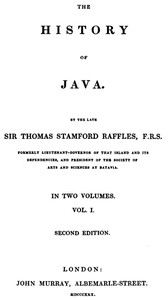
The History of Java, v. 1-2
Written by Thomas Stamford Raffles
Chaptra reads alongside you — AI insights, chapter breakdowns and reader discussions for every book. Join free
About this book
Read it with a club
Small groups reading the same books and talking as they go.


News
- 4 members
- 1,813 discussions
- Active Sep 11
Read The History of Java, v. 1-2 alongside people who are reading it too.
Also here: News Bulletin, Just Joking....
Chaptra Prime — paid clubs, every club feature, and unlimited reading support, for $5 a month or $60 once.
See PrimeReading guide
Themes, characters and key ideas in The History of Java, v. 1-2, written by Chaptra AI.
- about 30 hours
- advanced
- Informative
- Scholarly
- Detailed
Sir Thomas Stamford Raffles' "The History of Java" is a monumental early 19th-century historical and ethnographic account, meticulously detailing the geography, culture, and history of the Indonesian island of Java. Penned during his tenure as Lieutenant-Governor, the two-volume work serves as both a comprehensive scholarly endeavor and a justification of British colonial administration, particularly in contrast to the Dutch. Raffles explores the intricate dynamics of European colonialism, indigenous societies, and the complexities of governance, driven by a stated aim of justice and benevolence towards the Javanese people. The book provides invaluable insights into Javanese civilization, its historical significance in trade, and the multifaceted interactions between local populations and European powers, establishing itself as a foundational text in Southeast Asian studies.
“It has been my anxious desire to bring forward the Javanese to a proper rank in the scale of humanity, and to place them in that degree of estimation to which they are entitled.”
Key themes
- Colonialism and Governance
- The book is fundamentally a product and analysis of colonialism. Raffles explores the practicalities, justifications, and consequences of European rule over an indigenous population. He contrasts different colonial approaches (Dutch vs. British), advocating for a more 'enlightened' and 'benevolent' form of governance that, while still colonial, aimed for better administration and welfare for the Javanese people.
- Cultural Understanding vs. Orientalism
- Raffles demonstrates a genuine, albeit paternalistic, desire to understand Javanese culture, history, and society. He goes beyond mere economic exploitation to document intricate details of Javanese life. However, this understanding is filtered through an early 19th-century European lens, often categorizing and interpreting Javanese culture in ways that fit into existing 'Orientalist' frameworks, portraying it as exotic, ancient, and needing European guidance.
- The Pursuit of Knowledge and Enlightenment
- Raffles' work is a testament to the Enlightenment ideal of systematic knowledge acquisition and documentation. It reflects a belief that through comprehensive study, one can rationalize, understand, and ultimately 'improve' the world. His ambition to create an encyclopedic account of Java is driven by this scholarly impulse, aiming to fill gaps in European knowledge and to provide an informed basis for governance.
Worth discussing
How does Raffles' stated aim of 'justice and benevolence' align with, or diverge from, the realities of British colonialism in Java?
Chapter-by-chapter breakdowns, character arcs and the full thematic analysis come with a free account.
Discussions
No one has started one yet
Questions this book opens up
No discussions yet
Be the first to start a discussion about this book!
Sign up to start the discussionReviews
No reviews yet
Be the first to review this book!