
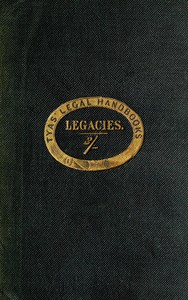
The hand-book of the law of legacies: containing a statement of the nature of legacies, and the accidents to which they are subjects; together with the rights of legatees, and the causes and manner of the ademption, cumulation, and abatement of their bequests
Written by Anonymous
Chaptra reads alongside you — AI insights, chapter breakdowns and reader discussions for every book. Join free
About this book
Reading guide
Themes, characters and key ideas in The hand-book of the law of legacies: containing a statement of the nature of legacies, and the accidents to which they are subjects; together with the rights of legatees, and the causes and manner of the ademption, cumulation, and abatement of their bequests, written by Chaptra AI.
- about 12 hours
- advanced
- instructive
- formal
- analytical
"The Hand-Book of the Law of Legacies" is an early 19th-century legal treatise designed to demystify the complexities of inheritance law, specifically concerning legacies. Authored anonymously, it aims to equip individuals, particularly legatees and executors, with a clear understanding of their rights, obligations, and the various circumstances that can affect bequests, such as ademption, cumulation, and abatement. The book posits that legal disputes often stem from ignorance, and it endeavors to mitigate these by providing structured definitions and practical guidance. It serves as a foundational text for navigating the intricate legal landscape surrounding post-mortem asset distribution, emphasizing clarity and preventative legal knowledge.
“Many legal disputes arise from ignorance of the law, especially during times of grief.”
Key themes
- Legal Clarity and Accessibility
- The central theme is the book's dedication to demystifying complex legal statutes and making them understandable to the layperson. The author explicitly states that ignorance of the law leads to disputes, positioning the handbook as a tool for public education and conflict prevention. This reflects a broader societal need for legal literacy beyond the legal profession.
- The Rights and Obligations in Inheritance
- The book meticulously details the legal standing of legatees (those receiving bequests) and the duties of executors (those administering the estate). It explores the entitlements of legatees, the conditions under which legacies are granted, and the responsibilities executors bear in ensuring proper distribution, reflecting the intricate balance of rights and duties inherent in estate law.
- The Contingency and Vulnerability of Bequests
- A significant portion of the handbook is dedicated to the 'accidents' or unforeseen circumstances that can alter or nullify legacies. This theme underscores the fragile nature of bequests, which are not absolute guarantees but are subject to various legal doctrines and estate realities, such as insufficient funds or changes in the testator's assets.
Worth discussing
How does 'The Hand-Book of the Law of Legacies' reflect the state of legal education and public access to legal knowledge in the early 19th century?
Chapter-by-chapter breakdowns, character arcs and the full thematic analysis come with a free account.
Discussions
No one has started one yet
Questions this book opens up
No discussions yet
Be the first to start a discussion about this book!
Sign up to start the discussionReviews
No reviews yet
Be the first to review this book!