
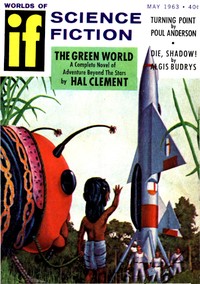
The Green World
Written by Hal Clement
Chaptra reads alongside you — AI insights, chapter breakdowns and reader discussions for every book. Join free
About this book
Reading guide
Themes, characters and key ideas in The Green World, written by Chaptra AI.
- about 8 hours
- intermediate
- mysterious
- scientific
- exploratory
Hal Clement's "The Green World" is a classic hard science fiction novel set on the enigmatic alien planet Viridis, where geophysicist Robin Lampert leads a scientific expedition. The narrative meticulously details the team's challenges as they explore Viridis's peculiar geophysical characteristics and encounter its dangerous, unique fauna, which have evolved under extreme conditions. Beginning with a preparatory visit to an alien zoo that foreshadows the perils, the story quickly moves to the team's helicopter deployment into the hazardous, unknown territories of Viridis. Clement masterfully blends rigorous scientific inquiry with the thrilling tension of survival, immersing readers in an alien ecosystem where every discovery could be a clue to the planet's evolutionary secrets or a deadly threat, emphasizing the ingenuity and resilience required for extraterrestrial exploration.
“"The universe is under no obligation to make sense to you. It merely is."”
Key themes
- Scientific Inquiry and Exploration
- This is the foundational theme of the novel, emphasizing the human drive to explore the unknown and understand the universe through rigorous scientific methodology. The expedition to Viridis is a testament to intellectual curiosity, where observation, hypothesis, and experimentation are paramount for both discovery and survival. The narrative delves into the practicalities of fieldwork on an alien world, showcasing the iterative process of science.
- Adaptation and Evolution
- The novel deeply explores how life adapts to extreme and peculiar environmental conditions, both for the indigenous Viridian species and the human explorers. Clement meticulously details the evolutionary pressures that shape alien biology, creating creatures that are logically consistent with their environment. Simultaneously, the human team must adapt their methods, technology, and even their thinking to survive and thrive on a world that defies their Earth-bound expectations.
- Humanity's Place in the Cosmos
- Through the lens of encountering a truly alien world, the novel prompts reflection on humanity's significance and limitations within the vastness of the universe. Viridis is presented not as a resource to be conquered, but as a complex system to be understood, forcing the human characters to shed anthropocentric biases and appreciate the sheer diversity of creation. It's a humbling experience that expands the understanding of what 'life' can be.
Worth discussing
How does Clement's approach to alien biology on Viridis challenge conventional ideas about life and evolution?
Chapter-by-chapter breakdowns, character arcs and the full thematic analysis come with a free account.
Discussions
No one has started one yet
Questions this book opens up
No discussions yet
Be the first to start a discussion about this book!
Sign up to start the discussionReviews
No reviews yet
Be the first to review this book!