
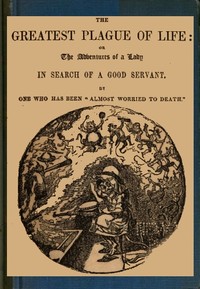
The Greatest Plague of Life: or, the Adventures of a Lady in Search of a Good Servant.
Written by Henry Mayhew,Augustus Mayhew
Chaptra reads alongside you — AI insights, chapter breakdowns and reader discussions for every book. Join free
About this book
Reading guide
Themes, characters and key ideas in The Greatest Plague of Life: or, the Adventures of a Lady in Search of a Good Servant., written by Chaptra AI.
- about 8 hours
- intermediate
- humorous
- satirical
- observational
Henry and Augustus Mayhew's "The Greatest Plague of Life" is a satirical Victorian novel that chronicles the misadventures of a middle-class lady, Mrs. Blossom, as she navigates the perpetual challenges of finding and retaining competent domestic servants. Through a series of humorous and often frustrating episodes, the book lampoons the prevailing 'servant problem' of the era, exposing the absurdities of both demanding employers and inept or dishonest employees. It offers a keen, albeit comedic, insight into the complex social dynamics and class tensions inherent in Victorian household management, ultimately serving as a social commentary on the domestic sphere.
“"Ah, the greatest plague of life, indeed, is the perpetual search for a good servant! One might sooner find a philosopher's stone than a competent housemaid."”
Key themes
- The 'Servant Problem' and Domestic Chaos
- This is the central theme, exploring the widespread Victorian anxiety and frustration associated with finding, training, and retaining reliable domestic staff. The book uses humor to highlight the constant turnover, the perceived failings of servants (real and imagined), and the resulting disruption to household order and the mistress's peace of mind.
- Victorian Class Relations and Social Hierarchy
- The book vividly, albeit satirically, portrays the rigid class distinctions of Victorian society, particularly between the middle-class employer and the working-class servant. It explores the power dynamics, mutual misunderstandings, and often unspoken tensions that characterized these relationships, revealing how deeply class permeated daily life.
- Gender Roles and Domesticity
- The novel implicitly critiques and highlights the prescribed role of the Victorian middle-class woman as the manager of the household. Mrs. Blossom's struggles underscore the immense pressure on women to maintain a perfect domestic sphere, often without adequate support or recognition, and how the 'servant problem' directly undermined their ability to fulfill this societal expectation.
Worth discussing
How does the Mayhews' satire illuminate the realities and anxieties of Victorian domestic life?
Chapter-by-chapter breakdowns, character arcs and the full thematic analysis come with a free account.
Discussions
No one has started one yet
Questions this book opens up
No discussions yet
Be the first to start a discussion about this book!
Sign up to start the discussionReviews
No reviews yet
Be the first to review this book!