
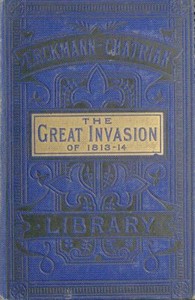
The Great Invasion of 1813-14; or, After Leipzig: Being a story of the entry of the allied forces into Alsace and Lorraine, and their march upon Paris after the Battle of Leipzig, called the Battle of the Kings and Nations
Written by Erckmann-Chatrian
Chaptra reads alongside you — AI insights, chapter breakdowns and reader discussions for every book. Join free
About this book
Reading guide
Themes, characters and key ideas in The Great Invasion of 1813-14; or, After Leipzig: Being a story of the entry of the allied forces into Alsace and Lorraine, and their march upon Paris after the Battle of Leipzig, called the Battle of the Kings and Nations, written by Chaptra AI.
- about 8 hours
- intermediate
- somber
- historical
- poignant
Erckmann-Chatrian's "The Great Invasion of 1813-14; or, After Leipzig" is a poignant historical novel that chronicles the devastating impact of the Napoleonic Wars on the civilian population of Alsace and Lorraine. Following the pivotal Battle of Leipzig, the narrative focuses on Jean-Claude Hullin, a humble shoemaker and veteran, and his adopted daughter Louise, as their tranquil village is engulfed by the advancing Allied forces. Through their personal struggles, the authors vividly portray the horrors of war, the resilience of ordinary people, and the stark contrast between the grand narratives of military glory and the brutal reality endured by those caught in the conflict. The story serves as a powerful anti-war statement, emphasizing human suffering over nationalistic triumph.
“The glory of empires is often built upon the shattered lives of the innocent.”
Key themes
- The Horrors of War
- This is the central theme, explored through the direct experiences of civilians caught in the invasion. The novel meticulously details the physical violence, the psychological trauma, the destruction of property, famine, and disease that accompany conflict, emphasizing the suffering over any perceived glory.
- The Resilience of the Human Spirit
- Despite the overwhelming suffering, the characters demonstrate remarkable endurance, adaptability, and an unwavering will to survive and rebuild. This theme highlights the strength of ordinary people in extraordinary circumstances, finding hope even in the darkest times.
- The Impact of Conflict on Civilian Life
- The novel specifically foregrounds the perspective of those not directly involved in combat but whose lives are irrevocably altered by war. It details the disruption of daily routines, the loss of livelihoods, the psychological burden of fear and uncertainty, and the forced displacement of populations.
Worth discussing
How do Erckmann-Chatrian challenge traditional heroic narratives of war through the experiences of ordinary civilians?
Chapter-by-chapter breakdowns, character arcs and the full thematic analysis come with a free account.
Discussions
No one has started one yet
Questions this book opens up
No discussions yet
Be the first to start a discussion about this book!
Sign up to start the discussionReviews
No reviews yet
Be the first to review this book!