
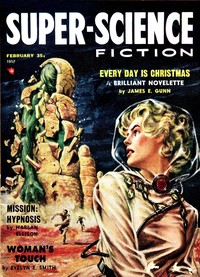
The great illusion
Written by Manly Banister
Chaptra reads alongside you — AI insights, chapter breakdowns and reader discussions for every book. Join free
About this book
Reading guide
Themes, characters and key ideas in The great illusion, written by Chaptra AI.
- about 8 hours
- intermediate
- mysterious
- philosophical
- thought-provoking
Manly Banister's mid-20th century science fiction novel, "The Great Illusion," follows Cliff Rowley, a psychic investigator from the Galactic Ethnological Survey Corps, as he delves into the seemingly primitive yet unsettling civilization on the closed world of Hume. Initially perceiving a simple, idyllic culture, Rowley's psychic abilities reveal a deeper, carefully maintained facade. He uncovers that the vibrant villagers and their society are, in fact, mental projections generated by the planet's true intelligent inhabitants: the trees of Hume. This profound discovery forces Rowley to confront complex questions regarding the nature of reality, identity, and the ethical implications of interfering with alien civilizations, ultimately redefining his understanding of truth and illusion.
“"Sometimes, the greatest truths are hidden behind the most convincing illusions."”
Key themes
- Perception vs. Reality
- This is the central theme, exploring how what we perceive as real can be an elaborate construction. The novel challenges the reader to question the reliability of their senses and assumptions when faced with an entirely different form of existence and deception. It delves into the subjective nature of truth.
- Nature of Identity and Culture
- The book probes what constitutes a 'person' or a 'culture.' If a civilization is merely a projection, does it still possess identity or cultural value? It forces a re-evaluation of anthropocentric definitions of life and society, questioning if sentience requires biological origin.
- Ethics of Interference
- A classic science fiction trope given a unique twist. Rowley faces a profound ethical dilemma: should he expose the truth of Hume's illusion, thereby shattering a carefully maintained existence, or should he respect the trees' right to solitude and their ingenious defense mechanism? It questions the morality of 'first contact' when the 'contact' itself is a deception.
Worth discussing
How does 'The Great Illusion' challenge our conventional understanding of 'life' and 'intelligence'?
Chapter-by-chapter breakdowns, character arcs and the full thematic analysis come with a free account.
Discussions
No one has started one yet
Questions this book opens up
No discussions yet
Be the first to start a discussion about this book!
Sign up to start the discussionReviews
No reviews yet
Be the first to review this book!