
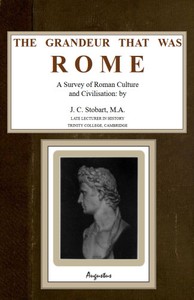
The Grandeur That Was Rome: a survey of Roman culture and civilisation
Written by J. C. (John Clarke) Stobart
Chaptra reads alongside you — AI insights, chapter breakdowns and reader discussions for every book. Join free
About this book
Reading guide
Themes, characters and key ideas in The Grandeur That Was Rome: a survey of Roman culture and civilisation, written by Chaptra AI.
- about 12 hours
- intermediate
- Informative
- Appreciative
- Analytical
J.C. Stobart's "The Grandeur That Was Rome" is an early 20th-century historical survey that aims to reframe the understanding of Roman civilization, particularly emphasizing the often-underappreciated Imperial period. Moving beyond traditional academic biases towards the Republic, Stobart argues for Rome's immense and enduring contributions to Western civilization, from political structures to cultural legacies. The book serves as a comprehensive account, inviting readers to appreciate the complexities, innovations, and lasting impact of Rome's evolution from a city-state to a vast empire. It challenges conventional historical narratives, asserting the necessity of acknowledging Rome's full historical trajectory to grasp its profound influence on modern Europe and human progress.
“The story of Rome is the story of human progress, in its most enduring and significant form.”
Key themes
- The Enduring Legacy of Roman Civilization
- This is the overarching theme of Stobart's work. He systematically argues that Roman law, governance, engineering, language, and administrative structures laid the indelible foundations for Western Europe. The book details how Roman innovations in public works, military organization, and the spread of a common culture across vast territories continue to influence modern societies.
- Reinterpreting Roman History: Republic vs. Empire
- A core argument of Stobart's is the need to rebalance historical perception, challenging the traditional academic bias that often romanticized the Roman Republic while viewing the Empire as a period of decline. Stobart champions the Imperial era as a necessary and beneficial evolution, crucial for Rome's ability to spread civilization and maintain stability over vast territories.
- The Evolution of Political Structures
- Stobart meticulously traces Rome's journey from a monarchical city-state to a complex Republic, and finally to an expansive Empire. This theme explores the challenges and adaptations of different political systems in response to internal pressures and external expansion, emphasizing the practical genius of the Romans in governance.
Worth discussing
How does Stobart challenge traditional views of Roman history, particularly regarding the Republic versus the Empire?
Chapter-by-chapter breakdowns, character arcs and the full thematic analysis come with a free account.
Discussions
No one has started one yet
Questions this book opens up
No discussions yet
Be the first to start a discussion about this book!
Sign up to start the discussionReviews
No reviews yet
Be the first to review this book!