
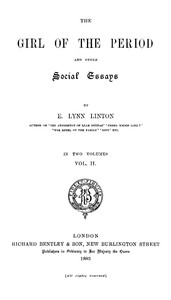
The Girl of the Period, and Other Social Essays, Vol. 2 (of 2)
Written by E. Lynn (Elizabeth Lynn) Linton
Chaptra reads alongside you — AI insights, chapter breakdowns and reader discussions for every book. Join free
About this book
Reading guide
Themes, characters and key ideas in The Girl of the Period, and Other Social Essays, Vol. 2 (of 2), written by Chaptra AI.
- about 8 hours
- advanced
- Analytical
- Critical
- Satirical
E. Lynn Linton's "The Girl of the Period, and Other Social Essays, Vol. 2" is a trenchant collection of late 19th-century social commentary, primarily dissecting the complex gender roles and evolving societal expectations of Victorian England. Linton, a keen observer, critiques both men and women for perceived emotional excesses and societal follies, using her essays to expose the hypocrisies of her era. The volume particularly scrutinizes the 'gushing man' as a figure of ridicule and delves into the delicate societal positioning of young women at the threshold of adulthood, epitomized by 'Sweet Seventeen.' Through incisive prose and a critical lens, Linton offers a fascinating historical document reflecting the anxieties and aspirations surrounding identity, decorum, and social change.
“"The gushing man, like his female counterpart, is one who, having lost the key of his emotions, leaves the door wide open for any stray feeling to wander in and out at will."”
Key themes
- Gender Roles and Societal Expectations
- This is the central theme, permeating all essays. Linton meticulously examines the prescribed behaviors, virtues, and limitations placed upon both men and women in Victorian society. She critiques the rigidity of these roles and the hypocrisy inherent in their enforcement, particularly regarding emotional expression and public conduct. The essays explore how individuals are expected to conform to idealized versions of masculinity and femininity, and the social consequences of deviation.
- Critique of Emotional Excess and Authenticity
- Linton is deeply concerned with the concept of 'gushing' – an overabundance or performative display of emotion that she views as insincere, uncontrolled, and often ridiculous. She argues for restraint and authenticity in emotional expression, contrasting genuine feeling with superficial sentimentality. This theme extends to both men and women, though the specific manifestations and societal reactions differ based on gender.
- The Transition to Adulthood for Young Women
- Focused particularly in the essays on 'Sweet Seventeen,' this theme explores the unique challenges, pressures, and expectations placed upon young women as they move from girlhood to womanhood. Linton examines the delicate balance between maintaining youthful innocence and preparing for adult responsibilities, marriage, and societal roles. She often highlights the dangers of superficiality, vanity, and misguided aspirations during this formative period.
Worth discussing
How does Linton define 'gushing' behavior, and what does her critique reveal about Victorian ideals of masculinity and femininity?
Chapter-by-chapter breakdowns, character arcs and the full thematic analysis come with a free account.
Discussions
No one has started one yet
Questions this book opens up
No discussions yet
Be the first to start a discussion about this book!
Sign up to start the discussionReviews
No reviews yet
Be the first to review this book!