
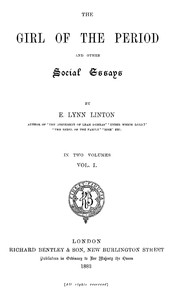
The Girl of the Period, and Other Social Essays, Vol. 1 (of 2)
Written by E. Lynn (Elizabeth Lynn) Linton
Chaptra reads alongside you — AI insights, chapter breakdowns and reader discussions for every book. Join free
About this book
Reading guide
Themes, characters and key ideas in The Girl of the Period, and Other Social Essays, Vol. 1 (of 2), written by Chaptra AI.
- about 8 hours
- intermediate
- critical
- didactic
- observational
E. Lynn Linton's "The Girl of the Period, and Other Social Essays, Vol. 1" is a trenchant collection of late 19th-century social critiques, primarily targeting the evolving roles and perceived moral decline of women. Linton contrasts an idealized, traditional femininity—marked by modesty, domesticity, and virtue—with the "modern woman," whom she portrays as shallow, materialistic, and vain, overly concerned with fashion and social status. Through sharp, often polemical essays, she laments the erosion of traditional values and warns of the detrimental impact these shifts have on individual character, relationships, and the fabric of society. The work serves as a significant historical document reflecting conservative anxieties about social change and women's emancipation during the Victorian era.
“The Girl of the Period, whose name is legion, and whose influence is beginning to be felt, is a creature who has no respect for modesty, no reverence for domesticity, no love for virtue, and no regard for integrity.”
Key themes
- The Changing Roles of Women
- This is the central theme, exploring the dramatic shifts in women's societal positions, expectations, and behaviors during the late 19th century. Linton views these changes with alarm, portraying them as a decline from an idealized past rather than as progress towards emancipation.
- Femininity and Ideal Womanhood
- Linton meticulously defines and champions a specific, conservative ideal of femininity, emphasizing modesty, domesticity, virtue, and self-effacement. She contrasts this sharply with what she perceives as a corrupted, performative, and materialistic modern femininity.
- Critique of Modernity and Moral Decline
- Linton's essays are fundamentally a conservative critique of the perceived moral and social decay brought about by modern trends. She argues that the pursuit of luxury, social status, and superficial appearances has corrupted traditional values, leading to a decline in genuine character and virtue across society.
Worth discussing
How do Linton's critiques of the 'Girl of the Period' reflect broader anxieties about social change in the late 19th century?
Chapter-by-chapter breakdowns, character arcs and the full thematic analysis come with a free account.
Discussions
No one has started one yet
Questions this book opens up
No discussions yet
Be the first to start a discussion about this book!
Sign up to start the discussionReviews
No reviews yet
Be the first to review this book!