
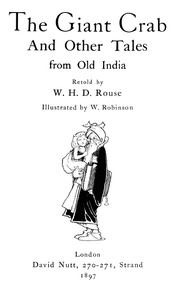
The Giant Crab, and Other Tales from Old India
Written by W. H. D. (William Henry Denham) Rouse
Chaptra reads alongside you — AI insights, chapter breakdowns and reader discussions for every book. Join free
About this book
Read it with a club
Small groups reading the same books and talking as they go.


News
- 4 members
- 1,813 discussions
- Active Sep 11
Read The Giant Crab, and Other Tales from Old India alongside people who are reading it too.
Also here: News Bulletin, Just Joking....
Chaptra Prime — paid clubs, every club feature, and unlimited reading support, for $5 a month or $60 once.
See PrimeReading guide
Themes, characters and key ideas in The Giant Crab, and Other Tales from Old India, written by Chaptra AI.
- about 8 hours
- beginner
- humorous
- cautionary
- uplifting
W. H. D. Rouse's "The Giant Crab, and Other Tales from Old India" is a late 19th-century collection that deftly retells traditional Indian folklore, primarily drawing from the Buddhist Jataka Tales. Designed for children, these fables feature a vibrant cast of animal characters who navigate moral dilemmas and illustrate timeless lessons through wit, courage, and sometimes folly. The titular story, "The Giant Crab," exemplifies the collection's spirit, depicting how a community of animals, led by clever elephants, overcomes a fearsome predator, thereby establishing themes of resourcefulness, community, and the consequences of unchecked power. This compilation serves as an engaging introduction to ancient wisdom, presenting cautionary tales and moral precepts in an accessible and entertaining format for young readers.
“Illustrative Quote: 'For greed, though it may bring short-lived power, always leads to its own undoing.'”
Key themes
- Consequences of Actions
- Central to all fables, this theme directly illustrates that every action, whether good or bad, ultimately leads to a proportional outcome. It serves as a cautionary principle, teaching accountability and the importance of ethical behavior.
- Morality and Ethics
- The overarching theme of the collection, exploring fundamental questions of right and wrong, good and evil, and virtuous living. Each tale aims to instill specific moral lessons, guiding readers toward ethical conduct and character development.
- Resourcefulness and Wit
- This theme highlights the power of intelligence and cleverness over brute force or sheer size. Many tales showcase how weaker or smaller characters can overcome formidable adversaries through strategic thinking and ingenuity.
Worth discussing
How do the animal characters in the tales reflect human virtues and vices? Provide specific examples.
Chapter-by-chapter breakdowns, character arcs and the full thematic analysis come with a free account.
Discussions
No one has started one yet
Questions this book opens up
No discussions yet
Be the first to start a discussion about this book!
Sign up to start the discussionReviews
No reviews yet
Be the first to review this book!