
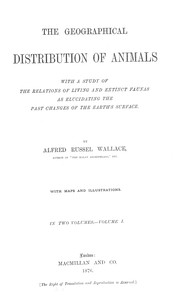
The Geographical Distribution of Animals, Volume 1: With a study of the relations of living and extinct faunas as elucidating the past changes of the Earth's surface
Written by Alfred Russel Wallace
Chaptra reads alongside you — AI insights, chapter breakdowns and reader discussions for every book. Join free
About this book
Reading guide
Themes, characters and key ideas in The Geographical Distribution of Animals, Volume 1: With a study of the relations of living and extinct faunas as elucidating the past changes of the Earth's surface, written by Chaptra AI.
- about 30 hours
- advanced
- Informative
- Analytical
- Systematic
Alfred Russel Wallace's "The Geographical Distribution of Animals, Volume 1" is a foundational scientific text from the late 19th century, meticulously exploring the global distribution of land animals. It systematically examines both living and extinct faunas, linking their patterns to past geological changes on Earth's surface. Wallace aims to establish a comprehensive framework for zoological geography, detailing the intricate relationships between physical environments, climate, vegetation, and the species they host. The volume's opening chapters lay the theoretical groundwork, defining key concepts and emphasizing the crucial role of historical geological events in shaping present-day biogeographical patterns, setting the stage for a detailed, evidence-based investigation.
“The geographical distribution of animals is a subject of such vast extent, and so intimately connected with almost every branch of natural history, that it is impossible to treat it otherwise than generally.”
Key themes
- Geological Determinism of Faunal Distribution
- This theme explores how Earth's dynamic geological history, including the formation and subsidence of landmasses, the creation of barriers, and past climatic shifts, has profoundly shaped the current distribution of animal species. Wallace meticulously details how ancient connections and isolations dictate present-day biogeographical patterns, arguing that an understanding of Earth's past is crucial for explaining its living present.
- Evolutionary Principles of Dispersal and Speciation
- Wallace implicitly and explicitly integrates Darwinian evolutionary principles to explain how species disperse, adapt to new environments, and become isolated, leading to speciation and unique regional faunas. The book demonstrates that current distribution patterns are not static but are the result of continuous processes of migration, adaptation, and natural selection acting over vast geological timescales.
- Systematic Classification and Regionalization
- Wallace's work emphasizes the necessity of a rigorous, systematic approach to understanding zoological geography. A major component of the book is the establishment of a hierarchical system for classifying the Earth's landmasses into distinct zoogeographical regions (e.g., Palearctic, Nearctic, Oriental). This methodological theme highlights the importance of precise categorization and detailed data organization for making sense of complex global patterns of life.
Worth discussing
How did Wallace's understanding of geological changes, pre-plate tectonics, influence his theories of animal distribution?
Chapter-by-chapter breakdowns, character arcs and the full thematic analysis come with a free account.
Discussions
No one has started one yet
Questions this book opens up
No discussions yet
Be the first to start a discussion about this book!
Sign up to start the discussionReviews
No reviews yet
Be the first to review this book!