
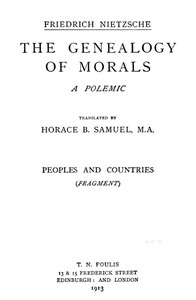
The Genealogy of Morals: The Complete Works, Volume Thirteen, edited by Dr. Oscar Levy.
Written by Friedrich Wilhelm Nietzsche
Chaptra reads alongside you — AI insights, chapter breakdowns and reader discussions for every book. Join free
About this book
Read it with a club
Chaptra's ideas and essays clubs — small groups reading the same books and talking as they go.


Books That Changed My Mind
Ideas and essays
- 5 members
- 4 discussions
- Active Sep 11
Not books you enjoyed. Books that moved you off a position you'd genuinely held for years. This is a Chaptra house club — set up and moderated by us to get the conversation going. Open to everyone; jump in anywhere.
Read The Genealogy of Morals: The Complete Works, Volume Thirteen, edited by Dr. Oscar Levy. alongside people who are reading it too.
Chaptra Prime — paid clubs, every club feature, and unlimited reading support, for $5 a month or $60 once.
See PrimeReading guide
Themes, characters and key ideas in The Genealogy of Morals: The Complete Works, Volume Thirteen, edited by Dr. Oscar Levy., written by Chaptra AI.
- about 8 hours
- advanced
- provocative
- analytical
- challenging
Friedrich Nietzsche's "The Genealogy of Morals" is a profound philosophical inquiry into the historical origins and evolution of moral concepts, particularly 'good' and 'evil'. Through three interconnected treatises, Nietzsche challenges traditional moral frameworks, arguing that dominant values are not timeless truths but rather historical constructs born from power dynamics and psychological states like *ressentiment*. He dissects the emergence of 'slave morality' from the resentment of the weak against the strong 'master morality,' and critically examines the pervasive influence of the ascetic ideal across religion, philosophy, and science. Ultimately, the work serves as a foundational text for understanding Nietzsche's critique of Western morality and his call for a revaluation of all values, urging readers to question the very foundations of their ethical beliefs.
“"There are no moral phenomena at all, but only a moral interpretation of phenomena."”
Key themes
- The Origins and Critique of Morality
- This is the central theme of the entire work. Nietzsche argues that moral values are not divinely ordained or universally true but are historical constructs, born from specific social, psychological, and linguistic conditions. He challenges the traditional view that 'good' and 'evil' are objective categories, asserting instead that they are products of human interpretation and power struggles, particularly the 'slave revolt in morality.'
- Ressentiment and Slave Morality
- Nietzsche introduces *ressentiment* (a French term for resentment, envy, and vengefulness, often repressed) as the psychological wellspring of 'slave morality.' This theme explores how the weak, unable to express their aggression directly against their oppressors, invert the values of the strong, thereby creating a moral system that demonizes strength and elevates weakness, humility, and suffering.
- The Ascetic Ideal
- This theme, primarily explored in the Third Treatise, examines the pervasive influence of the ascetic ideal—a commitment to self-denial, abstinence, and a turning away from the sensual world—across religion, philosophy, and even science. Nietzsche argues it provides meaning to suffering for those who are weak or nihilistic, but ultimately represents a will to power directed against life itself, devaluing earthly existence.
Worth discussing
How does Nietzsche's distinction between 'master morality' and 'slave morality' challenge conventional understandings of 'good' and 'evil'?
Chapter-by-chapter breakdowns, character arcs and the full thematic analysis come with a free account.
Discussions
No one has started one yet
Questions this book opens up
No discussions yet
Be the first to start a discussion about this book!
Sign up to start the discussionReviews
No reviews yet
Be the first to review this book!