
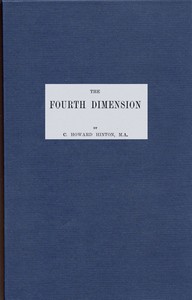
The Fourth Dimension
Written by Charles Howard Hinton
Chaptra reads alongside you — AI insights, chapter breakdowns and reader discussions for every book. Join free
About this book
Reading guide
Themes, characters and key ideas in The Fourth Dimension, written by Chaptra AI.
- about 12 hours
- advanced
- intellectual
- speculative
- challenging
Charles Howard Hinton's "The Fourth Dimension" is a pioneering late 19th-century scientific treatise that endeavors to demystify the abstract concept of a fourth spatial dimension. Through accessible language and thought experiments, Hinton guides readers beyond the limitations of three-dimensional perception, suggesting a reality far richer than our immediate senses convey. He employs analogies, most notably the 'plane world,' to illustrate how beings in a lower dimension might perceive their reality, unaware of a higher one. The work not only explores the mathematical and geometric properties of hyper-space but also delves into the profound philosophical implications of such an existence for human understanding and consciousness.
“"The aim of this book is to make the reader capable of conceiving of a fourth dimension in space."”
Key themes
- The Nature of Perception
- This is the foundational theme, as Hinton consistently argues that our understanding of reality is severely limited by our three-dimensional sensory apparatus. He uses analogies to demonstrate how beings in a lower dimension are inherently constrained in their perception of a higher one, directly mirroring our own situation. The book implicitly asks readers to transcend these limitations through intellectual exercise.
- Higher Dimensions and Reality
- Hinton's primary objective is to introduce and explore the concept of a fourth spatial dimension, not merely as a mathematical abstraction but as a potential aspect of reality. He delves into its geometric properties, how objects might exist and move within it, and how such a dimension could fundamentally alter our understanding of physical laws and phenomena.
- Cognitive Expansion and Intellectual Discipline
- The book is an extended exercise in intellectual discipline, challenging readers to break free from ingrained habits of thought. Hinton believes that understanding the fourth dimension requires not just intellectual comprehension but a fundamental shift in spatial intuition and imagination. He designs the book as a mental training regimen, pushing the boundaries of human cognitive abilities.
Worth discussing
How does Hinton's 'plane world' analogy help us understand the limitations of our own perception, and where might it fall short?
Chapter-by-chapter breakdowns, character arcs and the full thematic analysis come with a free account.
Discussions
No one has started one yet
Questions this book opens up
No discussions yet
Be the first to start a discussion about this book!
Sign up to start the discussionReviews
No reviews yet
Be the first to review this book!