
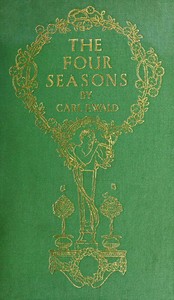
The Four Seasons
Written by Carl Ewald
Chaptra reads alongside you — AI insights, chapter breakdowns and reader discussions for every book. Join free
About this book
Reading guide
Themes, characters and key ideas in The Four Seasons, written by Chaptra AI.
- about 8 hours
- intermediate
- poetic
- allegorical
- contemplative
Carl Ewald's "The Four Seasons" is an early 20th-century poetic allegory that personifies the four seasons—Winter, Spring, Summer, and Autumn—as powerful princes vying for dominion over a newly created, desolate Earth. The narrative begins with the initial conflict between the formidable Winter and Summer, whose opposing forces create tension and imbalance. This dynamic sets the stage for the introduction of Spring and Autumn, who propose a cooperative partnership rather than a struggle for sole rule. Ultimately, the story culminates in the establishment of a harmonious cycle, where each season contributes its unique characteristics and powers, reflecting themes of balance, conflict resolution, and the inherent beauty and struggle within the natural world.
“Not available without access to the text.”
Key themes
- Balance and Harmony
- This is the central theme, explored through the narrative's progression from initial conflict to a state of equilibrium. The story ultimately advocates for the idea that true flourishing arises not from singular dominance, but from the cooperative interplay of diverse forces. The resolution where all four seasons rule in partnership exemplifies this balance, suggesting that all aspects, even opposing ones, are necessary for a complete and healthy system.
- Cycles of Nature
- The book explicitly explores the inherent cyclical nature of existence, using the seasons as a metaphor for life's continuous rhythm of birth, growth, decay, and renewal. It highlights that each phase, with its unique characteristics, is essential and contributes to the ongoing vitality of the whole, rather than being a linear progression.
- Conflict and Resolution
- The narrative begins with a clear depiction of conflict between opposing forces (Winter and Summer) and progresses to a resolution facilitated by mediation and cooperation. This theme explores how disparate elements can overcome initial antagonism to forge a functional and mutually beneficial relationship, moving from struggle to collaboration.
Worth discussing
How does Ewald's personification of the seasons as princes enhance the allegorical depth of the story?
Chapter-by-chapter breakdowns, character arcs and the full thematic analysis come with a free account.
Discussions
No one has started one yet
Questions this book opens up
No discussions yet
Be the first to start a discussion about this book!
Sign up to start the discussionReviews
No reviews yet
Be the first to review this book!