
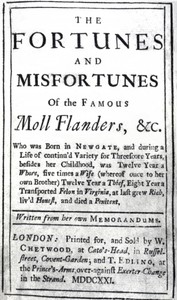
The Fortunes and Misfortunes of the Famous Moll Flanders
Written by Daniel Defoe
Chaptra reads alongside you — AI insights, chapter breakdowns and reader discussions for every book. Join free
About this book
Reading guide
Themes, characters and key ideas in The Fortunes and Misfortunes of the Famous Moll Flanders, written by Chaptra AI.
- about 15 hours
- advanced
- Gritty
- Realistic
- Satirical
Daniel Defoe's "The Fortunes and Misfortunes of the Famous Moll Flanders" chronicles the picaresque life of its eponymous protagonist, a woman born in Newgate Prison who navigates the harsh realities of 17th-century English society. Driven by a relentless desire for gentility and financial security, Moll resorts to multiple marriages, often bigamous, and eventually a career in crime, including prostitution and thievery. Her narrative is a pragmatic account of survival, moral ambiguity, and eventual repentance, offering a stark portrayal of the social and economic constraints faced by women of her era. The novel explores themes of class, gender, crime, and the elusive nature of virtue in a world where economic necessity often dictates moral choices, ultimately leading Moll to a paradoxical redemption in the American colonies.
“I was brought into the world in the prison of Newgate, where my mother was a criminal, and received sentence of death.”
Key themes
- Social Mobility and Class
- The novel meticulously details Moll's relentless pursuit of gentility and a higher social standing. Born in Newgate, Moll's greatest ambition is to be a 'gentlewoman,' and nearly all her actions—marriages, deceptions, and even crimes—are driven by this desire to escape her low birth and secure economic stability, which she equates with social status. The novel critiques a rigid class system where merit often matters less than inherited wealth or advantageous connections.
- Morality and Hypocrisy
- Moll's narrative is a constant negotiation between conventional morality and her pragmatic need for survival. She often expresses remorse for her sins, but her actions frequently contradict her stated principles, especially when economic security is at stake. The novel subtly critiques societal hypocrisy, where outward appearances of virtue are valued over genuine moral conduct, and where wealth can often whitewash past transgressions.
- Crime and Punishment
- Defoe provides a detailed and often sympathetic portrayal of the criminal underworld in 17th-century London. Moll's descent into crime is depicted as a direct consequence of economic necessity and societal pressures, rather than inherent evil. The novel explores the practicalities of thievery, the justice system's harshness (including transportation), and the moral ambiguities surrounding criminal acts when survival is at stake.
Worth discussing
How does Defoe portray the relationship between economic necessity and moral choices in Moll's life? Can her actions be justified by her circumstances?
Chapter-by-chapter breakdowns, character arcs and the full thematic analysis come with a free account.
Discussions
No one has started one yet
Questions this book opens up
No discussions yet
Be the first to start a discussion about this book!
Sign up to start the discussionReviews
No reviews yet
Be the first to review this book!