
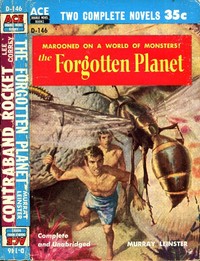
The Forgotten Planet
Written by Murray Leinster
Chaptra reads alongside you — AI insights, chapter breakdowns and reader discussions for every book. Join free
About this book
Reading guide
Themes, characters and key ideas in The Forgotten Planet, written by Chaptra AI.
- about 8 hours
- intermediate
- tense
- adventurous
- mysterious
Murray Leinster's "The Forgotten Planet" is a classic mid-20th-century science fiction novel centered on the theme of survival and adaptation in a uniquely hostile environment. The narrative follows Burl, a descendant of a shipwrecked crew, who lives a primitive existence on a planet humanity has long forgotten, battling gigantic insects and poisonous plant life. Stripped of all knowledge of his origins, Burl's journey transcends mere physical survival as he begins to intellectually evolve, seeking to understand his world and reclaim lost human ingenuity. The story masterfully blends adventure with a profound exploration of humanity's resilience, the cyclical nature of civilization, and the enduring quest for knowledge against overwhelming odds.
“He was a small man, on a giant planet, and the giants were not friendly.”
Key themes
- Survival and Adaptation
- This is the core theme, exploring humanity's capacity to endure and thrive in the most extreme and hostile conditions. The novel meticulously details Burl's physical and mental adaptations to a world designed to kill him, highlighting the innate drive for existence and the ingenuity born from necessity. It questions what it truly means to survive when stripped of all comforts and past knowledge.
- Loss and Rediscovery of Knowledge
- The novel profoundly explores the fragility of civilization and the immense value of accumulated knowledge. Humanity on the Forgotten Planet has lost its entire history and technological prowess. Burl's journey is a microcosm of civilization's rebirth, as he actively seeks to rediscover the forgotten truths of his ancestors, emphasizing that knowledge is not just power, but the very foundation of human identity and progress.
- Humanity's Place in Nature / Evolution
- Leinster presents a world where humanity is not the dominant species but merely another struggling organism. This theme examines how humanity adapts physically and mentally under immense evolutionary pressure. Burl's story is a dramatic exploration of both biological and intellectual evolution, suggesting that humanity's true strength lies not just in physical adaptation but in its unique capacity for abstract thought, innovation, and self-awareness.
Worth discussing
How does Burl's intellectual evolution compare to biological evolution, and what does the novel suggest about humanity's capacity for both?
Chapter-by-chapter breakdowns, character arcs and the full thematic analysis come with a free account.
Discussions
No one has started one yet
Questions this book opens up
No discussions yet
Be the first to start a discussion about this book!
Sign up to start the discussionReviews
No reviews yet
Be the first to review this book!