
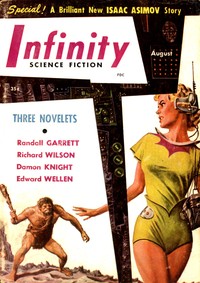
The Fool
Written by David Mason
Chaptra reads alongside you — AI insights, chapter breakdowns and reader discussions for every book. Join free
About this book
Reading guide
Themes, characters and key ideas in The Fool, written by Chaptra AI.
- about 8 hours
- intermediate
- ironic
- tragic
- humorous
David Mason's mid-20th century science fiction short story, "The Fool," presents a tragicomic exploration of cultural misunderstanding and the perils of idealism. It follows Duncan, an inept human teacher on the alien planet of the violent Tarchiki, as he futilely attempts to impart Earthly morals. His misguided efforts culminate in the accidental destruction of the Tarchiki's deity, Kachan, leading to his swift execution by a high priest. In a profound twist of irony, the Tarchiki misinterpret Duncan's dying words, elevating him to a new god and forming a religion around his perceived wisdom, thus highlighting the vast chasm between intent and reception in cross-cultural encounters.
“He spoke of peace, but his hands knew only clumsy destruction.”
Key themes
- Cultural Misunderstanding and Relativism
- This is the central theme, exploring the profound chasm between two vastly different cultures. Duncan's inability to grasp the Tarchiki's violent customs and their perception of his 'moral' teachings as absurd highlights the difficulty, if not impossibility, of imposing one culture's values onto another without deep comprehension. The story argues that 'truth' and 'morality' are often culturally relative.
- Unintended Consequences and Irony
- The entire narrative arc of 'The Fool' is driven by a profound sense of irony and the dramatic illustration of unintended consequences. Duncan's actions, meant to uplift, lead to his death, and his death, meant to be an end to his 'foolishness,' ironically elevates him to godhood. The story highlights how actions, especially across cultural divides, can have outcomes diametrically opposed to their original intent.
- The Folly of Idealism and Ethnocentrism
- The story directly critiques Duncan's idealistic, yet ultimately ethnocentric, mission. His belief that Earthly morals are universally applicable, coupled with his ineptitude in understanding the Tarchiki, exemplifies the folly of imposing one's values without considering the recipient culture. His good intentions pave a road not to enlightenment, but to tragedy and ironic absurdity.
Worth discussing
How does 'The Fool' challenge the idea of universal moral truths?
Chapter-by-chapter breakdowns, character arcs and the full thematic analysis come with a free account.
Discussions
No one has started one yet
Questions this book opens up
No discussions yet
Be the first to start a discussion about this book!
Sign up to start the discussionReviews
No reviews yet
Be the first to review this book!