
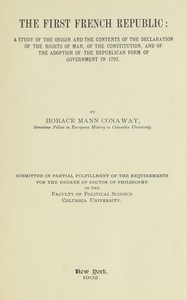
The first French Republic : $b A study of the origin and the contents of the declaration of the rights of man, of the constitution, and of the adoption of the republican form of government in 1792
Written by Horace Mann Conaway
Chaptra reads alongside you — AI insights, chapter breakdowns and reader discussions for every book. Join free
About this book
Reading guide
Themes, characters and key ideas in The first French Republic : $b A study of the origin and the contents of the declaration of the rights of man, of the constitution, and of the adoption of the republican form of government in 1792, written by Chaptra AI.
- about 8 hours
- advanced
- Analytical
- Informative
- Historical
Horace Mann Conaway's "The First French Republic" offers an early 20th-century academic examination of the foundational period of the First French Republic. The study meticulously investigates the intellectual and political origins of revolutionary ideas, particularly focusing on the Declaration of the Rights of Man and the subsequent adoption of a republican government in 1792. Conaway explores the socio-political and economic factors that instigated the French Revolution, highlighting the significant influence of American political thought on its leaders. Through a chronological analysis of debates within the National Assembly, the book elucidates the complex process by which France transitioned from monarchy to a new constitutional order. Ultimately, it provides insight into the historical context and ideological underpinnings of one of modern history's most pivotal political transformations.
“The genesis of the French Republic lies not merely in popular discontent, but in a profound ideological shift articulated through foundational documents.”
Key themes
- The Birth of Republicanism
- This theme examines the profound ideological and practical shift from monarchy to a republican form of government in France, focusing on the motivations, debates, and justifications for this radical transformation. Conaway details how the concept of a republic, initially a distant ideal, became a tangible reality in 1792, representing a fundamental redefinition of sovereignty from the monarch to the nation.
- The Enlightenment and Rationalism
- This theme explores how the intellectual currents of the Enlightenment, particularly ideas emphasizing reason, individual rights, and popular sovereignty, served as the fundamental ideological bedrock for the French Revolution and the creation of its foundational documents. Conaway illustrates how French thinkers, influenced by figures like Rousseau, Montesquieu, and Locke, provided the philosophical justification for dismantling the Old Regime and constructing a new society based on rational principles.
- Constitutionalism and the Rule of Law
- Conaway explores the revolutionary commitment to establishing a government based on a written constitution and the supremacy of law, as opposed to arbitrary rule or divine right. This theme emphasizes the revolutionary belief that a just society must be founded on clearly defined laws and a structured governmental framework that protects individual liberties and limits state power.
Worth discussing
How does Conaway's early 20th-century perspective shape his analysis of the French Revolution compared to contemporary historians?
Chapter-by-chapter breakdowns, character arcs and the full thematic analysis come with a free account.
Discussions
No one has started one yet
Questions this book opens up
No discussions yet
Be the first to start a discussion about this book!
Sign up to start the discussionReviews
No reviews yet
Be the first to review this book!