
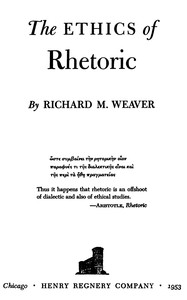
The ethics of rhetoric
Written by Richard M. Weaver
Chaptra reads alongside you — AI insights, chapter breakdowns and reader discussions for every book. Join free
About this book
Reading guide
Themes, characters and key ideas in The ethics of rhetoric, written by Chaptra AI.
- about 15 hours
- advanced
- philosophical
- analytical
- rigorous
Richard M. Weaver's "The Ethics of Rhetoric" is a foundational work asserting that all rhetoric is inherently ethical and "sermonic," meaning it implicitly or explicitly preaches a worldview and a set of values. Published in 1953, the book critiques the modern abandonment of transcendent truth, which Weaver argues has led to a relativistic and ethically compromised rhetoric. He systematically analyzes different argumentative forms, demonstrating how each reflects a speaker's moral and philosophical commitments. Ultimately, Weaver calls for a return to a rhetoric grounded in a firm apprehension of reality and guided by a profound sense of moral responsibility, seeing persuasion not just as a tool but as a powerful shaper of culture and character.
“All rhetoric is sermonic.”
Key themes
- The Ethical Nature of Rhetoric
- Weaver's central thesis is that rhetoric is never neutral; it is always 'sermonic,' implicitly or explicitly advocating for a particular worldview and set of values. He argues that every persuasive act stems from a speaker's ultimate vision of the good, making rhetoric inherently an ethical undertaking that demands moral responsibility from the rhetor.
- The Decline of Western Thought and the Erosion of Truth
- Weaver argues that the modern world has largely abandoned a commitment to transcendent truths and objective reality, leading to a relativistic intellectual climate. This decline, he contends, has severely impacted rhetoric, transforming it from a pursuit of truth into a mere instrument of persuasion, often devoid of ethical grounding. He traces this back to nominalism and the abandonment of the medieval scholastic tradition.
- The Power and Responsibility of Language
- Weaver views language as far more than a neutral medium; it is a powerful force that shapes thought, values, and reality itself. He emphasizes the profound responsibility that comes with using language, as it can either lead audiences towards truth and understanding or manipulate them through sophistry and emotional appeals. The choice of words and rhetorical strategies carries significant moral weight.
Worth discussing
Weaver states, 'All rhetoric is sermonic.' What does he mean by this, and how does this idea challenge common perceptions of rhetoric as a neutral tool?
Chapter-by-chapter breakdowns, character arcs and the full thematic analysis come with a free account.
Discussions
No one has started one yet
Questions this book opens up
No discussions yet
Be the first to start a discussion about this book!
Sign up to start the discussionReviews
No reviews yet
Be the first to review this book!