
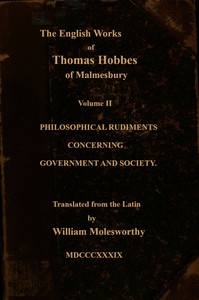
The English works of Thomas Hobbes of Malmesbury, Volume 02 (of 11)
Written by Thomas Hobbes
Chaptra reads alongside you — AI insights, chapter breakdowns and reader discussions for every book. Join free
About this book
Reading guide
Themes, characters and key ideas in The English works of Thomas Hobbes of Malmesbury, Volume 02 (of 11), written by Chaptra AI.
- about 12 hours
- advanced
- philosophical
- analytical
- rigorous
Volume 02 of 'The English Works of Thomas Hobbes' delves into the foundational principles of civil governance, presenting Hobbes's exploration of government, society, and the laws of nature. It critically asserts that humanity's natural state is one of perpetual conflict, a 'war of all against all,' driven by self-interest and mutual fear, challenging the notion of humans as inherently social beings. To escape this chaos, Hobbes argues for the necessity of a social contract, where individuals surrender some natural rights to an absolute sovereign authority. This establishment of a common power is crucial for maintaining order, ensuring peace, and protecting individual rights, thereby forming the bedrock of civil society and political organization.
“During the time men live without a common Power to keep them all in awe, they are in that condition which is called Warre; and such a warre, as is of every man, against every man.”
Key themes
- The State of Nature
- Hobbes's foundational premise describing human existence without government or common authority. It is a hypothetical condition of perpetual conflict, 'the war of all against all,' where individuals are driven by self-preservation, fear, and competition. In this state, there is no justice, property, industry, or culture, and life is 'solitary, poor, nasty, brutish, and short.'
- Sovereignty and Absolute Power
- Hobbes argues that the sovereign power, once established by the social contract, must be absolute, indivisible, and unquestionable. Its authority is paramount to prevent the state from collapsing back into the state of nature. The sovereign is the ultimate arbiter of law and justice, and subjects have no right to rebel, as doing so would undermine the very foundation of peace and order.
- The Social Contract
- The voluntary agreement among individuals to mutually transfer some of their natural rights (particularly the right to use violence) to a common sovereign power. This contract is the rational solution to escape the state of nature, forming the basis of civil society and legitimate government, ensuring peace, order, and security in exchange for absolute liberty.
Worth discussing
To what extent does Hobbes's 'state of nature' accurately reflect human behavior without government, and what are the implications of this view for political systems?
Chapter-by-chapter breakdowns, character arcs and the full thematic analysis come with a free account.
Discussions
No one has started one yet
Questions this book opens up
No discussions yet
Be the first to start a discussion about this book!
Sign up to start the discussionReviews
No reviews yet
Be the first to review this book!