
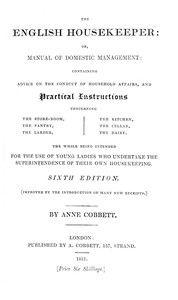
The English Housekeeper: Or, Manual of Domestic Management: Containing advice on the conduct of household affairs and practical instructions concerning the store-room, the pantry, the larder, the kitchen, the cellar, the dairy; the whole being intended for the use of young ladies who undertake the superintendence of their own housekeeping
Written by Anne Cobbett
Chaptra reads alongside you — AI insights, chapter breakdowns and reader discussions for every book. Join free
About this book
Reading guide
Themes, characters and key ideas in The English Housekeeper: Or, Manual of Domestic Management: Containing advice on the conduct of household affairs and practical instructions concerning the store-room, the pantry, the larder, the kitchen, the cellar, the dairy; the whole being intended for the use of young ladies who undertake the superintendence of their own housekeeping, written by Chaptra AI.
- about 10 hours
- intermediate
- Instructive
- Practical
- Didactic
Anne Cobbett's "The English Housekeeper: Or, Manual of Domestic Management" is a mid-19th-century practical guide designed for young ladies embarking on their housekeeping journey. The manual comprehensively covers various aspects of home management, from organizing the store-room to culinary practices, emphasizing efficiency and economy. Cobbett critiques the contemporary educational system for neglecting essential domestic skills, advocating for practical experience over purely academic learning. Through detailed instructions and advice, the book aims to equip women, particularly those of moderate means, with the necessary knowledge to run a well-ordered and efficient household. It serves as both a practical instructional text and a commentary on the societal value of homemaking during its era.
“It is a lamentable truth that many young women of the present day are ill-prepared for the domestic responsibilities that await them.”
Key themes
- Domesticity and Women's Role
- This is the overarching theme, exploring the central role of women in managing the household and the societal expectations placed upon them. Cobbett frames domestic management not just as a duty but as a skilled profession requiring intelligence and dedication, crucial for the well-being and reputation of the family. The book details the multifaceted responsibilities, from financial oversight to culinary expertise, asserting the housekeeper's position as the 'architect' of home comfort and economy.
- Practical Education vs. Academic Learning
- Cobbett strongly advocates for a practical education, particularly for women, in contrast to what she perceives as an overemphasis on academic or ornamental learning. She argues that true preparedness for life, especially for women, lies in mastering essential domestic skills that ensure the efficient and economical running of a home. This theme critiques contemporary educational practices and champions a more utilitarian approach.
- Efficiency and Economy
- Central to Cobbett's philosophy of housekeeping are the principles of efficiency and economy. The book consistently emphasizes prudent management of resources, minimizing waste, and maximizing utility in all household operations. This includes careful budgeting, smart purchasing, proper storage to prevent spoilage, and resourceful use of ingredients. These principles are presented as essential not just for financial stability but also for moral rectitude and social standing.
Worth discussing
How does Cobbett's critique of 19th-century female education resonate with or differ from contemporary debates about practical vs. academic learning?
Chapter-by-chapter breakdowns, character arcs and the full thematic analysis come with a free account.
Discussions
No one has started one yet
Questions this book opens up
No discussions yet
Be the first to start a discussion about this book!
Sign up to start the discussionReviews
No reviews yet
Be the first to review this book!