
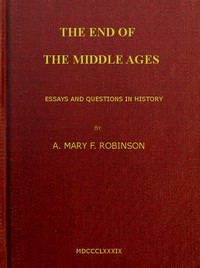
The End of the Middle Ages: Essays and Questions in History
Written by A. Mary F. (Agnes Mary Frances) Robinson
Chaptra reads alongside you — AI insights, chapter breakdowns and reader discussions for every book. Join free
About this book
Reading guide
Themes, characters and key ideas in The End of the Middle Ages: Essays and Questions in History, written by Chaptra AI.
- about 8 hours
- advanced
- scholarly
- reflective
- inquisitive
A. Mary F. Robinson's "The End of the Middle Ages" is a late 19th-century collection of historical essays exploring the complex transition from the medieval era to modernity. The author delves into the societal dynamics, pivotal figures, and movements that shaped the decline of the Middle Ages, scrutinizing how its influences persisted. Through a series of inquiries, she examines groups like the Beguines and Weaving Brothers, highlighting their blend of piety, social responsibility, and nascent heterodoxy. Dedicated to Mr. Symonds, the work reflects on collaborative historical inquiry and the challenge of separating past from present. Robinson ultimately questions whether the Middle Ages truly concluded or merely transformed, leaving an enduring legacy.
“"To Mr. Symonds, whose profound impact on collaborative historical inquiry has illuminated these very paths of discovery, this volume is dedicated, a testament to shared intellectual pilgrimage."”
Key themes
- The Nature of Historical Transition
- This is the core theme, exploring whether the 'end' of the Middle Ages was a definitive break or a gradual, complex transformation. Robinson questions the arbitrary nature of historical periodization and highlights the enduring influence of medieval structures and ideas into the modern era.
- Religious Heterodoxy and Social Reform
- Robinson explores the interplay between religious piety, social responsibility, and movements that deviated from orthodox church teachings. She examines how groups like the Beguines and Weaving Brothers, while often rooted in sincere faith, developed practices and beliefs that were seen as challenging to established religious authority, paving the way for future reforms or conflicts.
- The Nature of Historical Inquiry and Interpretation
- The book itself is a meditation on how history is written and understood. Through her dedication and introductory remarks, Robinson reflects on the collaborative nature of scholarship and the inherent difficulties in objectively interpreting the past, especially in separating it from the historian's own contemporary context.
Worth discussing
How does Robinson challenge the traditional understanding of the 'end' of the Middle Ages? What evidence does she present for continuity versus discontinuity?
Chapter-by-chapter breakdowns, character arcs and the full thematic analysis come with a free account.
Discussions
No one has started one yet
Questions this book opens up
No discussions yet
Be the first to start a discussion about this book!
Sign up to start the discussionReviews
No reviews yet
Be the first to review this book!