
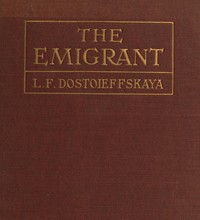
The Emigrant
Written by L. F. (Liubov Fedorovna) Dostoevskaia
Chaptra reads alongside you — AI insights, chapter breakdowns and reader discussions for every book. Join free
About this book
Reading guide
Themes, characters and key ideas in The Emigrant, written by Chaptra AI.
- about 12 hours
- advanced
- melancholy
- introspective
- spiritual
Irene Mstinskaia, a young Russian woman, embarks on a profound journey of self-discovery and spiritual quest, fleeing a homeland that has left her deeply disillusioned. Seeking solace and a new identity in Rome, a city that both enchants and challenges her, Irene grapples with a past marked by loneliness and a superficial upbringing. The novel meticulously details her psychological struggles, her existential despair, and her complex relationship with faith. Her path leads her to a transformative encounter with Père Etienne, a priest who guides her deeper into an exploration of Catholicism, offering a potential balm for her searching soul.
“Rome, in all its ancient splendor, was merely a grand mirror reflecting my own profound, inescapable emptiness.”
Key themes
- Faith and Spirituality
- Central to Irene's journey is her evolving and complex relationship with faith, specifically her deep exploration of Catholicism. Initially, her struggles are existential and rooted in secular disillusionment, but her profound encounter with Père Etienne shifts her focus towards spiritual answers to her despair. The novel delves into the nature of belief, doubt, spiritual seeking, and the potential for divine solace as a remedy for human suffering.
- Identity and Belonging
- Irene's emigration is a literal and metaphorical journey to forge a new identity, free from the constraints and disillusionment of her Russian past. She grapples with who she is outside her homeland, seeking a place where she genuinely belongs, both culturally and spiritually. Rome serves as a complex backdrop for this redefinition of self, challenging her perceptions and forcing her to confront her inner solitude.
- Existential Despair and Disillusionment
- Irene's journey is fundamentally driven by a profound sense of despair and disillusionment, first with Russian society and then with the inherent challenges of finding meaning even in her idealized new home. This theme explores the human condition of searching for purpose in a seemingly indifferent world, grappling with loss, isolation, and the inherent emptiness that can accompany a lack of spiritual or social grounding.
Worth discussing
How does Irene's physical emigration from Russia mirror her internal search for identity and meaning?
Chapter-by-chapter breakdowns, character arcs and the full thematic analysis come with a free account.
Discussions
No one has started one yet
Questions this book opens up
No discussions yet
Be the first to start a discussion about this book!
Sign up to start the discussionReviews
No reviews yet
Be the first to review this book!