
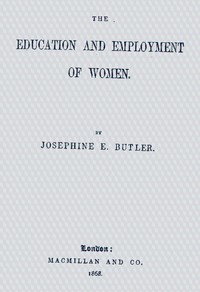
The education and employment of women
Written by Josephine Elizabeth Grey Butler
Chaptra reads alongside you — AI insights, chapter breakdowns and reader discussions for every book. Join free
About this book
Read it with a club
Small groups reading the same books and talking as they go.


News
- 4 members
- 1,813 discussions
- Active Sep 11
Read The education and employment of women alongside people who are reading it too.
Also here: News Bulletin, Just Joking....
Chaptra Prime — paid clubs, every club feature, and unlimited reading support, for $5 a month or $60 once.
See PrimeReading guide
Themes, characters and key ideas in The education and employment of women, written by Chaptra AI.
- about 8 hours
- advanced
- serious
- thought-provoking
- critical
Josephine Elizabeth Grey Butler's "The Education and Employment of Women" is a pivotal late 19th-century social critique advocating for expanded opportunities for women. Butler meticulously dissects the prevailing societal conventions that confined women, arguing they were out of step with the economic realities faced by a significant portion of the female population, including wives, widows, and spinsters. Through statistical data, poignant anecdotes, and rational argumentation, she exposes the harsh limitations in employment—primarily teaching, domestic service, and sewing—and the debilitating prejudice women endured. The book serves as a passionate call to action, emphasizing that improved education and diverse employment for women are not merely matters of individual justice but crucial for the moral and economic advancement of society as a whole.
“It is a cruel irony that society demands economic self-sufficiency from women, yet systematically denies them the means to achieve it.”
Key themes
- Women's Rights and Equality
- This is the overarching theme, as Butler fundamentally argues for the equal treatment and opportunities for women in society. She challenges the prevailing patriarchal norms that limited women's roles to the domestic sphere, advocating for their right to education, economic independence, and public contribution.
- Economic Independence for Women
- A central pillar of Butler's argument is the necessity for women to achieve economic self-sufficiency. She uses statistical evidence to show that many women were already working out of necessity and critiques the social structures that made this work precarious, undervalued, and limited, leading to widespread economic vulnerability.
- Education as Empowerment
- Butler passionately argues that comprehensive and rigorous education is not just a right but a fundamental tool for women's empowerment. She views education as the means to unlock women's intellectual potential, prepare them for diverse professions, and enable them to contribute meaningfully to society beyond traditional domestic roles.
Worth discussing
How does Butler's use of statistical evidence strengthen her arguments, and how effective would this approach be today?
Chapter-by-chapter breakdowns, character arcs and the full thematic analysis come with a free account.
Discussions
No one has started one yet
Questions this book opens up
No discussions yet
Be the first to start a discussion about this book!
Sign up to start the discussionReviews
No reviews yet
Be the first to review this book!